
August 20, 2025
Veterans Affairs—Ahead of the Field for FY26 Appropriations
In its first appropriations action of the year, the Senate passed its Military Construction and Veterans Affairs FY26 bill on August 1 by a vote of 89-7. It was part of a three-bill package that the Senate considered before departing for August recess. This action followed House passage of their FY26 Veterans Affairs funding bill, H.R. 3944, on a June 25 218-206 vote. To close followers of VA funding issues, the differences between the House and Senate funding levels seem unusual—in particular, a $16 billion difference in medical funding. However, recall that the House started its appropriations work with a June 5 subcommittee markup, before the details of Trump’s FY26 budget request were released.
By the time the Senate Appropriations Committee formulated its Military Construction VA bill, VA had revised its budget request and provided additional budget details. Other subcommittees, such as Defense, had similar problems with late budget documentation while having a short timeframe to complete their bills.
For this analysis, FBIQ will use the revised FY26 VA budget estimates, which will form the basis for House and Senate negotiations for FY26 appropriations.
FY26 TRUMP VA BUDGET
The President proposed a robust VA budget of $435.7 billion, a 10% increase over the FY25 funding level, with a stated focus on serving veterans experiencing homelessness, suicide prevention, providing access to medical care and accelerating the Electronic Health Record Modernization (EHRM) project that kicked off in 2018 during the first Trump Administration. The VA budget also has a goal of increasing efficiency and eliminating redundancy. In March, VA made plans to cut 15% of VA’s workforce (close to 80,000 jobs) but has pulled back from that target. On July 7, VA announced it will reduce staff by 30,000 this fiscal year—17,000 jobs have been cut, and another 12,000 employees are expected to leave by September 30. Secretary Collins indicated satisfaction with that reduction, saying staff levels were “in the right direction” and “a department-wide RIF is off the table.” VA is in the midst of several reorganizations and consolidation of functions, while having vacancies in key management positions, such as Chief Information Officer.
- Veterans Homelessness programs would be funded at $3.46 billion, a $100 million increase over FY25. In addition, VA requested new legislation and $1.1 billion in funding within medical care for a housing assistance program called BRAVE (Bridging Rental Assistance for Veteran Empowerment).
- Suicide Prevention Outreach is planned at $698 million, an increase of $118 million over FY25.
- The EHRM project is requested at $3.6 billion, an increase of $2.2 billion to support the 13 planned deployments in in 2026.
- Medical Community Care funding, which allows veterans to get health care from external providers in their communities, will increase 26%, from $38 billion in FY25 to $48 billion in Secretary Collins fully supports access to community care, focusing on reducing barriers to veterans. On August 4, he announced that veterans will receive full year authorizations for community care access for 30 conditions, rather than requiring them to return to VA every three to six months for reauthorizations. Overall, Trump’s FY26 VA budget, which includes both mandatory and discretionary funding, is $435.7 billion (not including medical collections). It is comprised of three major funding sources: standard mandatory funding, primarily for direct payments to veterans for compensation and pensions; the newer (since 2022) PACT Act/Toxic Exposures Fund (TEF), which is scored as mandatory spending but must be directly appropriated; and discretionary appropriations. See a summary of the FY26 request compared to FY25 budget levels in Chart I.
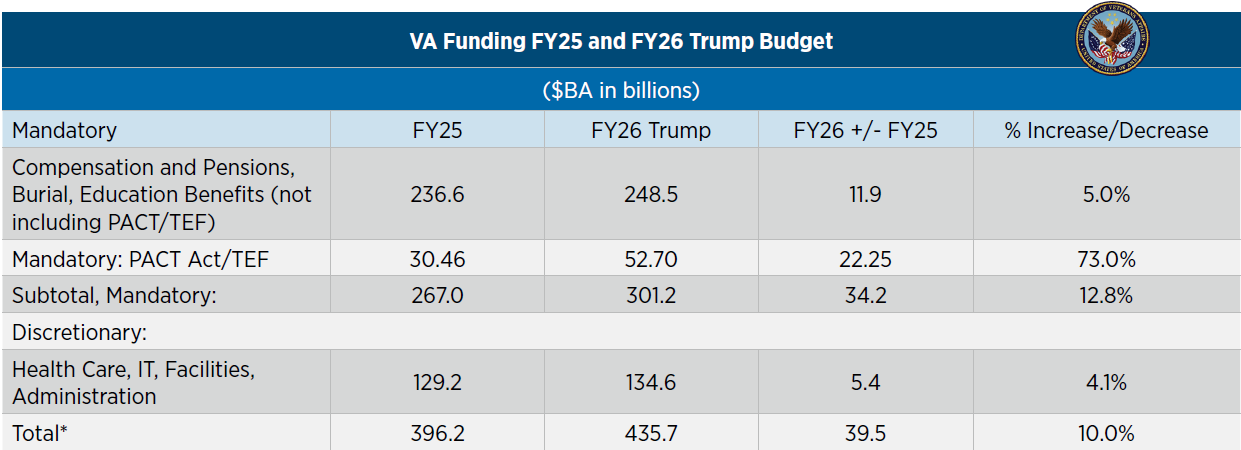
*Does not include medical collections or Recurring Expenses Transformational Fund. Chart I: VA FY25 and FY26 Budget request. Source: VA FY26 Revised Budget
PACT ACT FUNDING
The Sergeant First Class Heath Robinson Honoring Our Promise to Address Comprehensive Toxics (PACT) Act of 2022 was enacted to cover medical and associated needs for veterans who suffered toxic exposure, such as conditions caused by proximity to burn pits. The legislation set up the TEF but does not provide funding. It must be specifically provided by law and is not automatically renewed. In addition to health care services, the PACT Act directs funding for the mission-critical backbone to deliver those services—information technology, staff, and facilities. VA guidance for use of TEF funding (see text box) include these services, as well as restrictions and reporting requirements. The FY26 Trump budget requests an increase in TEF funding of $53 billion, a 73% increase over FY25. Chart II summarizes TEF funds from FY23 to the FY27 Trump request.
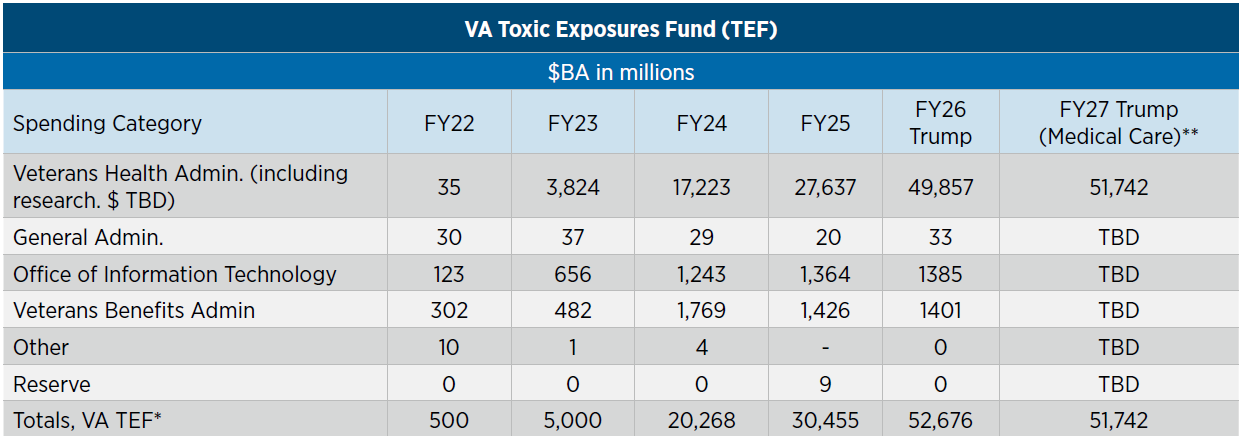
Chart II. Source: President’s Budget, House, Senate appropriations committees *Totals may not add due to rounding. The majority of TEF funds are available for 5 years; FY26 and FY27 funds are requested to be available indefinitely. **The FY26 budget requests FY27 TEF funds for Medical Care, but VA is likely to include funds for OIT, VBA, Research and other functions in FY27.
BIG PICTURE FOR VA AND CONGRESSIONAL ACTION
With the increasingly significant amount of PACT Act/TEF funding, combining TEF and discretionary funds offers the clearest picture of VA’s program funding. As seen in Chart III, VA has realized 12.4% average growth (nominal dollars) from FY21 to FY26. Health care is the cost driver, and within that, the fastest growing program is Medical Community Care, which now accounts for about 40% of veteran medical visits and 30% of the medical care budget. Community care is an integral piece of VA medical care and relies on resources such as administrative functions and personnel in Medical Support and Compliance and support from Medical Services.
The FY26 Senate appropriations bill provides VA with: $133.3 billion in discretionary funding, $610 million below the Trump budget of $134.6 billion; fully funds TEF at the $52.7 billion request; and no FY27 TEF funding.
The House mark is $149.6 billion in discretionary funding, $15 billion over the revised Trump budget, but close to the original FY26 Trump budget (the House acted in early June before the administration updated its budget request). The House bill funds the administration’s proposed new BRAVE housing assistance program within VA medical care at $970 million versus the $1.1 billion request; the Senate did not fund BRAVE. The House fully funded TEF for FY26 at the $52.7 billion request and amended their bill in full committee to add the requested $51.7 billion for FY27. Another difference is the approach to EHRM. The House funded $2.5 billion of the requested $3.5 billion, while the Senate funded EHRM close to the request. In final action, the House and Senate are likely to come within 1% of the overall Trump VA budget, although some accounts may differ.
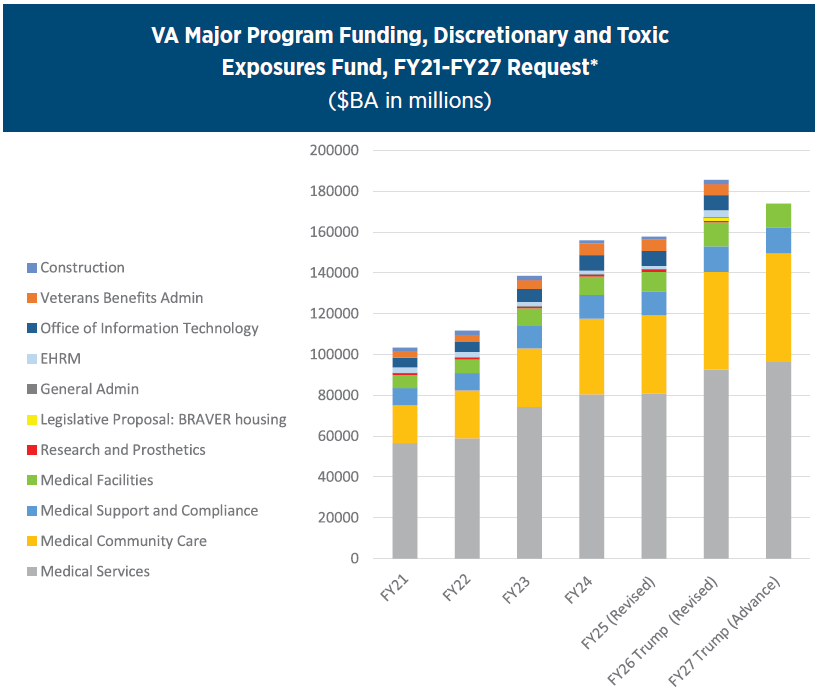
Chart III. Does not include mandatory VA funding for veteran compensation and pensions, medical care collections, or Recurring Expenses Transformational Fund. Source: VA FY26 and Prior Budgets, FY21-FY26 Appropriations Acts, FBIQ. *FY27 Advance Funding is only requested for Medical Care accounts; Other FY27 funding levels are TBD with the FY27 budget request in February 2026.
INFORMATION TECHNOLOGY
VA’s FY26 Information Systems budget is $5.908 billion in discretionary funds and $1.385 billion from the TEF. The discretionary piece is a $493 million reduction from the FY25 level, spurred by transition of some systems to steady-state, and efficiencies, with $184 million of the decrease due to personnel cuts. The budget states “the 2026 request preserves core operations while accelerating modernization in infrastructure readiness, cybersecurity, and artificial intelligence (AI).” For AI, the budget identifies Decision Intelligence & Automation – Artificial Intelligence for a $16 million increase, to a total of $39 million. Other areas of increase include Financial Management Business Transformation (+$45 million), Cyber Security Monitoring – Zero Trust Architecture (+$97 million), and IRP – Server/Storage & Network Infrastructure (+$54 million). The largest increase is for Disability Compensation – Benefits Claims Processing (+$132 million).
Both the House and Senate rejected a VA proposal to make the IT budget authority available for three years, rather than one, and that the money be provided in a single account, rather than the subaccounts that Congress prescribes. The Senate provided the full amount requested, $5.908 billion, the House provided $5.882 billion, and both provided TEF funding for IT as requested.
EHRM
As VA moves into a 13-site EHRM deployment, its budget request of $3.5 billion, an increase of $2.2 billion (+160%) reflects the intensity of activity. The House funded $2.5 billion of the requested $3.5 billion, while the Senate funded EHRM close to the $3.5 billion request. Congress maintained conditions over the EHRM funds, including not allowing transfers of funds, Government Accountability Office quarterly reviews, cost reports, and fencing funding (see text box below).
Allowable Uses of TEF Funds:
“Any expenses incident to the delivery of Veterans’ health care and benefits associated with exposure to environmental hazards in the active military, naval, air, or space service, including administrative expenses, such as information technology and claims processing and appeals…Modernization, development, and expansion of capabilities and capacity of information technology systems and infrastructure of the Veterans Benefits Administration.”
VA Financial Policy Guide,
April 16, 2025
OUTLOOK FOR FY26
Currently, VA and the rest of the federal government are managing under a full year continuing resolution (CR). With few legislative days left in September when Congress returns from recess, the House and Senate will need to pass a CR, and the President will need to sign it, to prevent a partial government shut down.
Because the House and Senate have both passed FY26 Military Construction VA Appropriations bills, it is possible that the appropriation could be conferenced, and VA could get a normal, on-time FY26 appropriation. It would be very attractive to attach a CR for the rest of government to it. It is also possible to win the lottery. The vastly more likely outcome is a short-term CR for all of government. Some members of Congress may instead wish to pursue another full year CR or even prefer a shutdown versus a compromise. VA is insulated in part, since VA Medical Care is appropriated through advance funding, and the FY25 CR included FY26 VA medical funding and $6 billion for the TEF. However, a shutdown would affect all other parts of VA, from information technology to building maintenance, and be harmful to the confidence in VA services and care that Secretary Collins, the administration, and the Congress want to earn from veterans and their families.