

The One Big Beautiful Bill Act (OBBBA) P.L. 119-21, enacted on July 4, 2025, included $191 billion for the Department of Homeland Security (DHS), $152.6 billion for the Department of Defense (DOD), $12.5 billion for the Federal Aviation Administration (FAA), $10 billion for the National Aeronautics and Space Administration, and $2.9 billion for the NNSA at the Department of Energy (DOE). OBBBA made the funds available for obligation until FY29 with outlays occurring until FY34.
As FBIQ has previously reported, OBBBA gave these agencies broad authority over allocation of these funds. OBBBA included requirements that agencies provide Congress detailed spending plans for this funding. The administration has consistently ignored these requirements and subsequent requests from Congress.
From the outset, we argued that outlays from OBBBA would be delayed until FY26 with most of that occurring after FY26 appropriations were enacted. We argued that the broad flexibility OBBBA provided agencies over allocation of these funds gave them an incentive to wait until FY26 appropriations were finalized before ramping up implementation of these new initiatives. We began FY26 with a 43-day shutdown that prevented most agency planners from working. Afterwards, each of the affected agencies faced continuing resolutions and protracted deliberations over FY26 appropriations that delayed OBBBA spending plan implementation further.
Chart I shows how delayed enactment of appropriations affected OBBBA implementation and procurement activity for DHS, DOD, FAA, NASA, and DOE. Because DOD and FAA were funded in the same FY26 multi-bill appropriations law their projections are consistent. The same is true for NASA and DOE. DHS is broken into two parts because Congress decided to fund all of DHS except the US Border Patrol and Immigration and Customs Enforcement (ICE) in a regular FY26 DHS Appropriations bill (DHS I) and the balance in a second budget reconciliation bill—the $70 billion Secure America Act finally enacted June 8 — that FBIQ covered extensively in our June report (DHS II). Because funding for these two groups of DHS agencies were adopted at different times, their OBBBA-funded initiatives will roll out on different schedules.
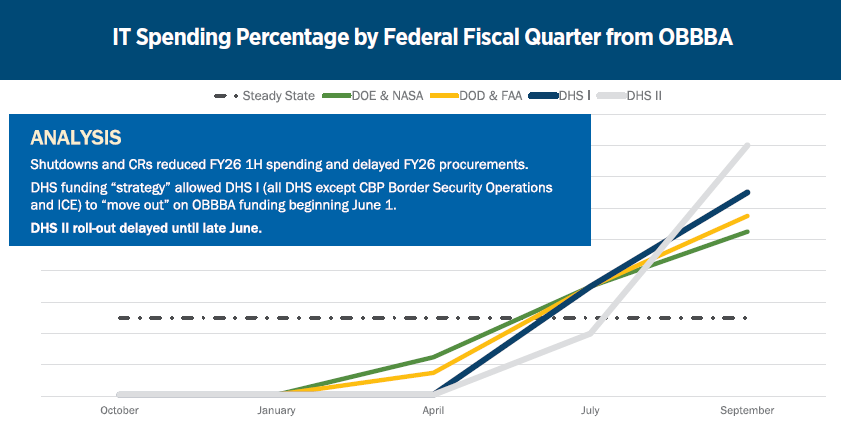
Chart I. Source: FBIQ
For political reasons, we estimated that procurement activity related to key Trump Administration initiatives funding in OBBBA would ramp up in the second half of FY26 and exceed CBO projections for FY27 and FY28. Why? Because the Trump Administration wants to obligate these resources before mid-term elections that could change control of the House, the Senate, or both. Failure to do so would make it easier for a Democrat-controlled House or Senate to rescind unobligated funding from Trump priority programs that Democrats oppose and potentially offset the cost of their own funding initiatives.
There is a clear precedent for this. During the Biden Administration, both Democrats and Republicans agreed to rescind billions in unobligated Inflation Reduction Act-funded resources for Internal Revenue Service modernization to offset increases for other programs with more bipartisan support.
All of the apportionment data released by the Office of Management and Budget (OMB) since OBBBA was enacted supports FBIQ’s forecast. Apportionments govern the timing for agency financial commitments. In several cases, OMB-approved apportionments assume a disproportionate share of obligations in FY26. In others, 100% of OBBBA-approved funding is available to be obligated in FY26. We view these targets as aspirational.
Protracted deliberations over FY26 appropriations have delayed the process. But now all systems are “go for launch.” Contracting activity for these OBBBA-funded initiatives will look very different in FY27, and, based on OMB’s apportionment strategy, be far more front-loaded.
In FBIQ’s forecast, OBBBA-funded contracting activity should accelerate every month through January 2027 regardless of what happens in the November elections.