

On November 12, as part of the legislative package reopening the government, the President signed three FY26 spending bills into law, the largest of which was the Military Construction, Veterans Affairs, and Related Agencies Appropriations Act, 2026 (Division D). That law, along with VA’s advance appropriations from FY25, will make $445.5 billion available to the Department of Veterans Affairs (VA), nearly $50 billion, or +12.4%, over FY25. As summarized in Chart I, this includes $259.6 in mandatory funding, primarily for disability compensation and pension payments; $133.2 billion in discretionary funding for medical care, facilities, information technology and other VA infrastructure, and $52.7 billion for the PACT Act/Toxic Exposures Fund (TEF) to provide care and treatment for veterans exposed to service-connected environmental hazards. Note that as of FY26, discretionary funding accounts for just 30% of VA’s total resources.

*Does not include medical collections or Recuring Expenses Transformational Fund. Chart I: Totals may not add due to rounding. Source: Military Construction, Veterans Affairs, and Related Agencies Appropriations Act, 2026, and Joint Explanatory Statement, Senate Appropriations Committee
FY26 ROUNDUP – DISCRETIONARY FUNDING
While Congress largely stuck to the Trump Administration budget request for FY26, there were a few changes to both numbers and policy. See Chart II for comparisons of FY26 enacted funding levels to FY25 and the Trump FY26 budget, highlighted below.
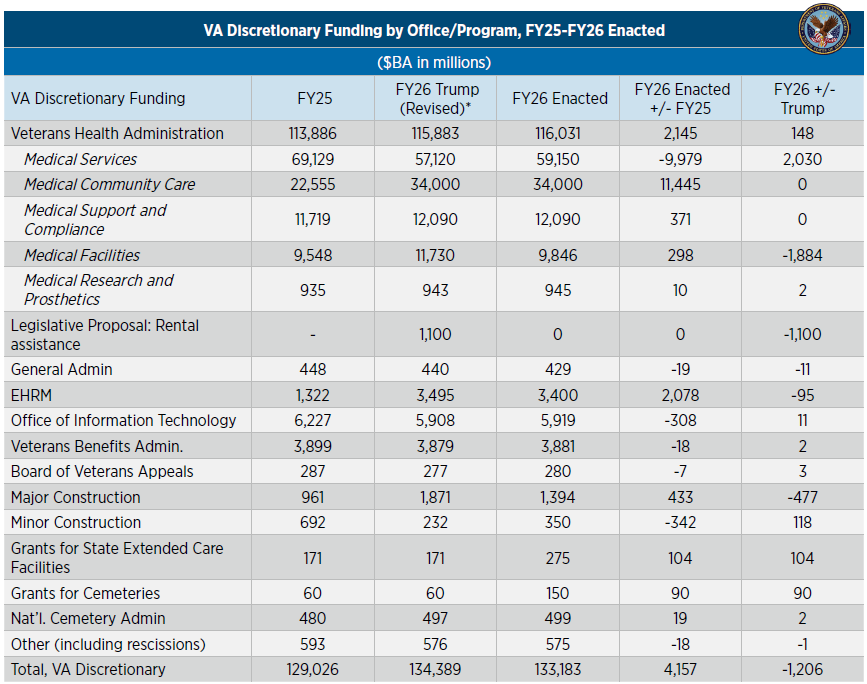
*FY26 Request was significantly revised in June 2025. Chart II: Totals may not add due to rounding. Source: Joint Explanatory Statement to accompany Military Construction, Veterans Affairs, and Related Agencies Appropriations Act, 2026
In final FY26 action, Congress exceeded the Trump VA budget for several accounts, including:
- Medical Facilities ($9.8 Billion funded, +$146 million over Trump budget, with the increase specifically targeted to Non-recurring Maintenance needs);
- Information Technology ($5.9 billion, +$11 million over Trump budget);
- Medical and Prosthetic Research ($945 million, +$2 million); and
- Veterans Benefits administration ($3.9 billion, +$2 million for implementation of the Senator Elizabeth Dole 21st Century Veterans Healthcare and Benefits Improvement Act).
Accounts funded below the Trump budget were Electronic Health Record Modernization (EHRM), which was requested at $3.5 billion and funded at $3.4 billion, and General Administration, which was cut by $11 million. The final FY26 appropriation did not include $1.1 billion for a new rental assistance program in the Trump budget, but the administration retreated from that initial proposal. While Congress cut new Major Construction funding by $477 million, they directed $900 million to be made available for construction from VA’s Recurring Expenses Transformation Fund.
PACT ACT/TEF
The FY26 appropriations act includes $52.7 billion in funding for the Cost of War Toxic Exposures Fund (TEF), to remain available until expended, as requested. This is a $22 billion, or 73% increase, over last year’s TEF level. The cost of serving veterans under the PACT Act legislation has dwarfed initial estimates by the Congressional Budget Office, the administration, and veteran advocates. In addition to compensation payments and health care services, the PACT Act of 2022 directed funding for the mission-critical backbone to deliver those services—information technology, staff, and facilities. The Trump FY25 VA budget included planned distribution of TEF funds, and Congress modified that distribution, as reflected in Chart III. Congress asserted both its strong support of TEF and its need for full oversight in the statement accompanying the appropriation, stating “The agreement includes a provision with quarterly reporting requirements on the status of the TEF, and an expenditure plan for funds provided.”

*$1.5 billion of the funds provided are not program-directed in the FY26 appropriations law. Chart III: Totals may not add due to rounding. The majority of TEF funds are available for 5 years; FY26 and FY27 funds are requested to be available indefinitely. Source: VA FY26 Budget, Joint Explanatory Statement to accompany Military Construction, Veterans Affairs, and Related Agencies Appropriations Act, 2026
INFORMATION TECHNOLOGY
The Trump request for VA Information Technology Systems was $5.9 billion and VA asked for the funds in one single, flexible account. The appropriators funded VA IT $11 million over the budget request but did not acquiesce to the single funding line. Instead, as seen in Chart IV, IT is funded in three subaccounts: Operations and Maintenance; Salaries and Expenses; and Development, Modernization and Enhancement, as has been the practice for over a decade. Transfers between the accounts are allowed with Congressional approval. One modification is that, within the O&M funds, $119 million is carved out for Activations. In addition to the $5.9 billion in discretionary funding, $1.4 billion in TEF funds is provided for IT. The TEF funds may be used for any of the IT sub-accounts but need to be addressed in the required TEF spend-plan.
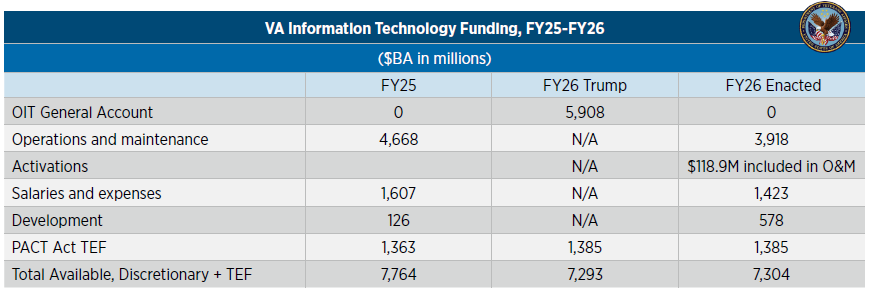
Chart IV. Source: VA FY26 Budget, Joint Explanatory Statement to accompany Military Construction, Veterans Affairs, and Related Agencies Appropriations Act, 2026
The appropriations report highlights VA’s adoption of an Identity Governance and Administration solution (a policy-based approach to managing user access and controlling risk), and directs VA to report on the phased plan, rollout, and costs within 90 days. The report also asserts the need for a better technology platform for veterans to access their benefits. Other IT focus areas that either the House or Senate addressed in their committee-approved reports will need to be addressed by VA, including VistA as a Service directives that both House and Senate appropriators included.
ELECTRONIC HEALTH RECORD MODERNIZATION (EHRM)
The agreement provides $3.4 billion for EHRM, $95 million below the Trump request, but $2.1 billion over the FY25 level. The increase over FY25 reflects the re-started deployment schedule for 13 new sites in 2026. The oversight for this VA activity, reporting requirements, and funding restrictions continue to be comprehensive, focused, and bipartisan.
The agreement expects the Department to hold its contractors accountable. The Department is expected to work closely with Oracle Cerner to resolve usability problems and dramatically improve training to ensure that when deployments restart the new system can be adopted easily by clinicians and healthcare staff.
FY26 VA Appropriations Act,
Explanatory Statement
The FY26 appropriations law continues the practice of withholding a portion of funding (for FY26, 30% of the total EHRM appropriation) until VA has met congressional oversight requirements, including the Secretary providing “an updated life-cycle cost for the program, a facility-by-facility deployment schedule, certification on healthcare performance baseline metrics” and other data related to staffing and patient safety.
Further, VA must provide quarterly financial reports, monthly briefings and quarterly performance reports on timing and milestones to Congress, and the Government Accountability Office is directed to provide comprehensive technical quarterly reviews. The appropriators note that this account is the sole funding source for EHRM and that transfers are prohibited. Funding for the newly announced EHRM system integration contract was not requested by VA and is not addressed in the appropriation.
OVERSIGHT AND SPENDING CONTROL
While Congress funded VA at or above the Trump budget levels, it added requirements focused on implementation of spending laws, staffing, and service levels.
The VA Secretary is required to send a spend plan to the House and Senate within 30 days, which will be December 12.
The measure includes more extensive restrictions on transfers subject to congressional approval than in prior years. For example, new reporting on staffing and performance metrics for the Veterans Crisis Line (VCL) is required, and there is a complete prohibition on reducing staffing, hours of operation, or services of VCL or any VA suicide prevention program.
For benefits, VA is required “to maintain staffing levels to facilitate the Department’s own goals, including that benefits claims are adjudicated according to the 125-day goal.”
Other provisions stipulate that the VA Secretary provide Congress advance notice of cancellation of any contract in excess of $10 million, with a written explanation of the effect of the cancellation on veterans services and VA employees, and a plan to mitigate any service issues. Expect the oversight to continue at an intense level throughout FY26, as the administration continues to pursue efficiencies, adjust staffing, and revisit contracts, and Congress flexes its “power of the purse.”