
December 08, 2025
Defense OBBBA Spending Plan Details Begin to Emerge
During the longest government shutdown in history, the Senate and House Armed Services Committees began negotiations with the Department of Defense over spending priorities for the $156 billion for the defense activity funding appropriated in PL 119-21, the One Big Beautiful Bill Act (OBBBA). In the unprecedented inclusion of funding for defense as part of the reconciliation process, the defense authorization committees provided defense spending through mandatory appropriations not vetted through the defense appropriation committees. Instead, the vaguely written legislative language for 13 different topical sections has been refined through a series of informal back and forth exchanges between the authorization committees and the department, resulting in a spend plan for the first $89.3 billion.
In confirmation hearings, Senate Armed Services Committee Chair Wicker (R-MS) asked nominated senior officers if they intend to follow congressional intent for reconciliation funding in the OBBBA. On October 9, 2025, during the Air Force Chair of Staff confirmation hearing of recently retired General Kenneth S. Wilsbach, Chairman Wicker asked the question at the start of his opening statement, asking for “a simple yes or no”. Wilbash’s answer was “I will carry out funding in accordance with the law and I will strive to do my best with the intent of Congress as well.” When Wicker pointed out “That’s not an explicit answer is it?”, Wilbash said, “No, but I will definitely follow the law, Senator.”
Wilsbash’s answer to Wicker’s question exposes the tension between the defense committees, both authorizers and appropriators, and the Department of Defense over the power of the purse. The authorization committees, due to the vague, unspecific funding language in each section of title II of the OBBBA, find themselves negotiating spending plans after funding is appropriated. Pre-Trump, this process would have benefited both the Hill and the Pentagon as the executive branch honored Congress’ role in appropriations and worked with the committees to place funding where recommended. However, in the second Trump administration, after having tested the waters in the first term, has repeatedly consolidated executive power over appropriated funding and believes allocation authority lies within the White House, through the Office of Management and Budget. Therefore, a spend plan for just over half of the total reconciliation funding is newsworthy.
The OBBBA made $150 billion of the $156 available for the Department of Defense, starting in FY25 to September 30, 2029. The Congressional Budget Office published cost estimates showing how the funds would be spent over five fiscal years, with the majority of the spending to be spent in the near term, FY26 and FY27. In this first spend plan of $89.9 billion, $82.2 billion is allotted to FY26 and FY27. Coincidently, CBO estimated outlays are the same—$82.2 billion—but that estimate predates the spend plan and is subject to change.
FBIQ has seen details of the emerging spend plan. In the current fiscal year, the big winner in the spend plan is Sec. 20002 Enhancement of Department of Defense Resources for Shipbuilding, making up a third of the total for FY26. This includes shipbuilding funding spread across traditional shipbuilding appropriation accounts, most notably Shipbuilding and Conversion, Navy. The breakout shows two DDG-51 Destroyers, one Virginia Class submarine, two of three OBBBA-authorized T-AO Oilers, eight medium landing ships, and a four-ship block buy for Landing, Platform Dock (LPD – amphibious warship). Also included in the spend plan is $2.3 billion for small and medium unmanned surface vessel production.
The Air Force will be able to increase readiness across multiple areas with $2.1 billion for equipment readiness, $2.4 billion for facilities, sustainment, restoration, and maintenance (FSRM) in addition to their share of a $1 billion FSRM allocation for all military services.
In other funding, the service is allocated $3.1 billion for F-15EX production and $2.4 billion dedicated to the B-21 bomber.
Elsewhere, the spend plan shows industrial base grants and funds receive close to $5 billion combined. Border Operations as well as offensive cyber operations have allocations of $1 billion each. The Army and Marine Corps share $1.5 billion for depot maintenance, which should help readiness.
Spend plans for the remainder of the reconciliation funding are expected by December, perhaps ensuring the reconciliation funding syncs with the FY26 National Defense Authorization Act, usually agreed to in December. While reconciliation funding provides great flexibility, both Congress and the Pentagon agree in spending the majority of the funding before the mid-term election next year, allowing the majority party to fund their defense priorities before a possible change in control of the House or Senate. During the shutdown, reconciliation funding was used for military pay, as those funds were already available, much unlike the FY26 Defense Appropriation bills.
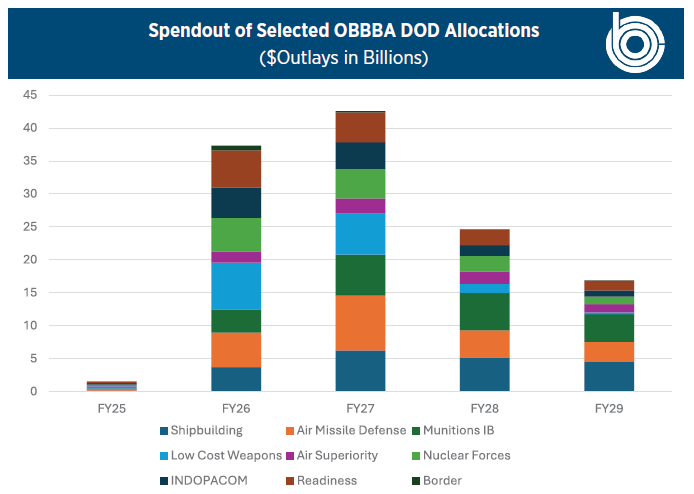
Chart I. Source: CBO. Note: Figures exclude quality of life, readiness, and some smaller funding allocations
The regular FY26 Trump defense budget request of $848 billion will be funded through the Appropriations Committee. The House defense committees would match the request; the Senate would add funding. Regardless of the eventual topline (now punted to Jan. 30, 2026), these spend plans for OBBBA funding are a signpost for individual program priorities.
Reconciliation funding for defense provides resources for the Pentagon to continue operating at a higher level than before under a continuing resolution or during a lapse in appropriations. It also allows defense appropriations toplines to be suppressed until FY29 with this alternative multi-billion-dollar reconciliation-funded infusion, which could be compared to the Overseas Contingency Operations account used to keep the base budget within sequestration amounts. By focusing on readiness, shipbuilding, and industrial base issues, the department can prepare for war, and $150 billion is just enough to provide that headstart.