
December 15, 2025
FY26 Appropriations – The Clock Is Ticking, Again
The first FY 2026 continuing resolution (PL 119-37) expires on January 30, 2026. After a 43-day government shutdown, one would think that Congress has incentive to move expeditiously to complete the nine remaining appropriations bills that constitute over 89% of discretionary spending. You would be wrong.
There has been no progress in resolving the major differences between the President, the House, and Senate in spending toplines for defense and non-defense spending. The President’s proposal to cut non-defense spending by 23% has largely been rejected. The House bills cut non-defense programs by 6% and the Senate bills are roughly at FY25 levels. (see Chart I). There has been no progress on addressing the many so-called poison pill riders. There has been no progress on reaching agreement with the Trump Administration and OMB Director Vought on the power of the purse issues (purported authority for the President to unilaterally cancel spending approved by Congress and signed by the President).
The House has passed only five of the twelve bills, and the Senate has passed only three. Only three have become public law (Military Construction-VA, Legislative Branch, and Agriculture-FDA). There has been no movement in the four weeks since the shutdown ended. Fiscal conservatives have objected to Senate Appropriations Chair Collins’ (R-ME) efforts to move a five-bill minibus (Defense, Labor-HHS-Ed, Interior, Commerce-Justice-Science, Transportation-HUD). House Appropriations Chair Cole’s efforts to bring up a three-bill minibus or individual bills have not yet been approved by Speaker Johnson (R-LA). None of the remaining nine bills have been conferenced between the House and Senate (see Chart III).
In the meantime, it appears that OMB will be happy if most of the remaining bills are funded through a full-year continuing resolution at FY 25 funding levels, similar to the outcome enacted in March of 2025 for FY25 (PL 119-4). While such a continuing resolution would reject the President’s proposal to cut non-defense programs by 23%, OMB Director Vought continues to assert that congressionally-approved funding levels are ceilings, and that the President could choose to spend less.
As a result of this uncertainty, solicitations for procurements are expected to be delayed well into the Spring, even for the significant funding for the Department of Defense (DOD) and the Department of Homeland Security (DHS) provided in the One Big Beautiful Bill Act (OBBBA) in July (PL119- 21). With little of the $150 billion appropriated for DOD and the $191 billion appropriated for DHS in OBBBA for fiscal years 2025-2029 apportioned by OMB, most OBBBA funds may not be available before the second half of FY 26.
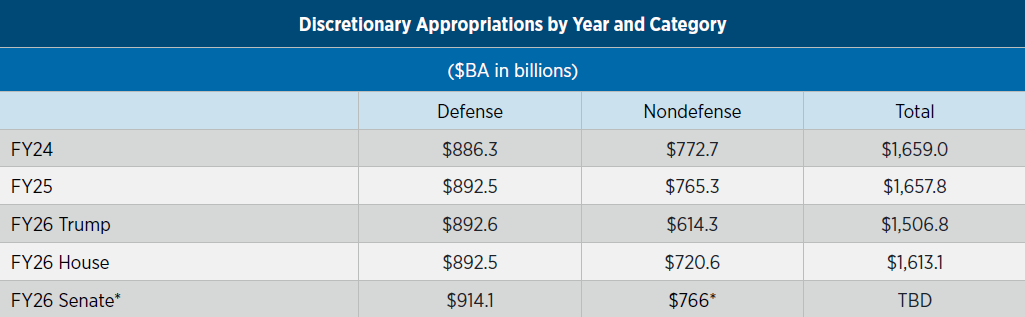
*The Senate hasn’t acted on all the FY26 funding bills covering civilian agencies yet; the $766 billion figure is an estimate. Chart I. Source: OMB, CBO, House and Senate Appropriations Committees, FBIQ.
DIFFERENCES
The resolution of the defense and non-defense toplines for FY26, whether through an agreement or via a full-year continuing resolution at FY25 levels will have significant consequences. Differences, some significant, exist for major programs between FY25, the request, the House, and the Senate. For examples, see Chart II.
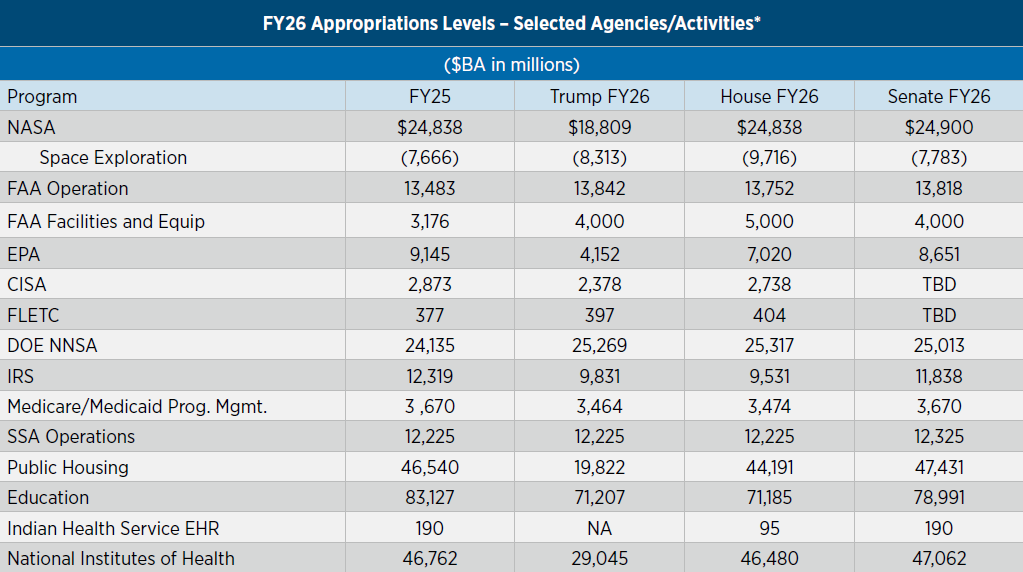
Chart II. Source: House and Senate Appropriations Committee reports. *Figures do not include funding provided in OBBBA.
LOOKING AHEAD
Next week, Congress is expected to send the National Defense Authorization Act to the president. The agreement authorizes FY26 defense spending at $901 billion, $8 billion (+1%) above FY25 and above the president’s FY26 request. However, OMB director Vought has said the administration does not want appropriations for defense to be higher than the FY26 CR level of $897.6 billion.
With major differences between the House and Senate for Education, Housing, EPA, NIH, IRS, Defense, and other programs, it is unlikely that funding decisions will be made for technology and related programs before late January, further delaying procurement decisions until the Spring.
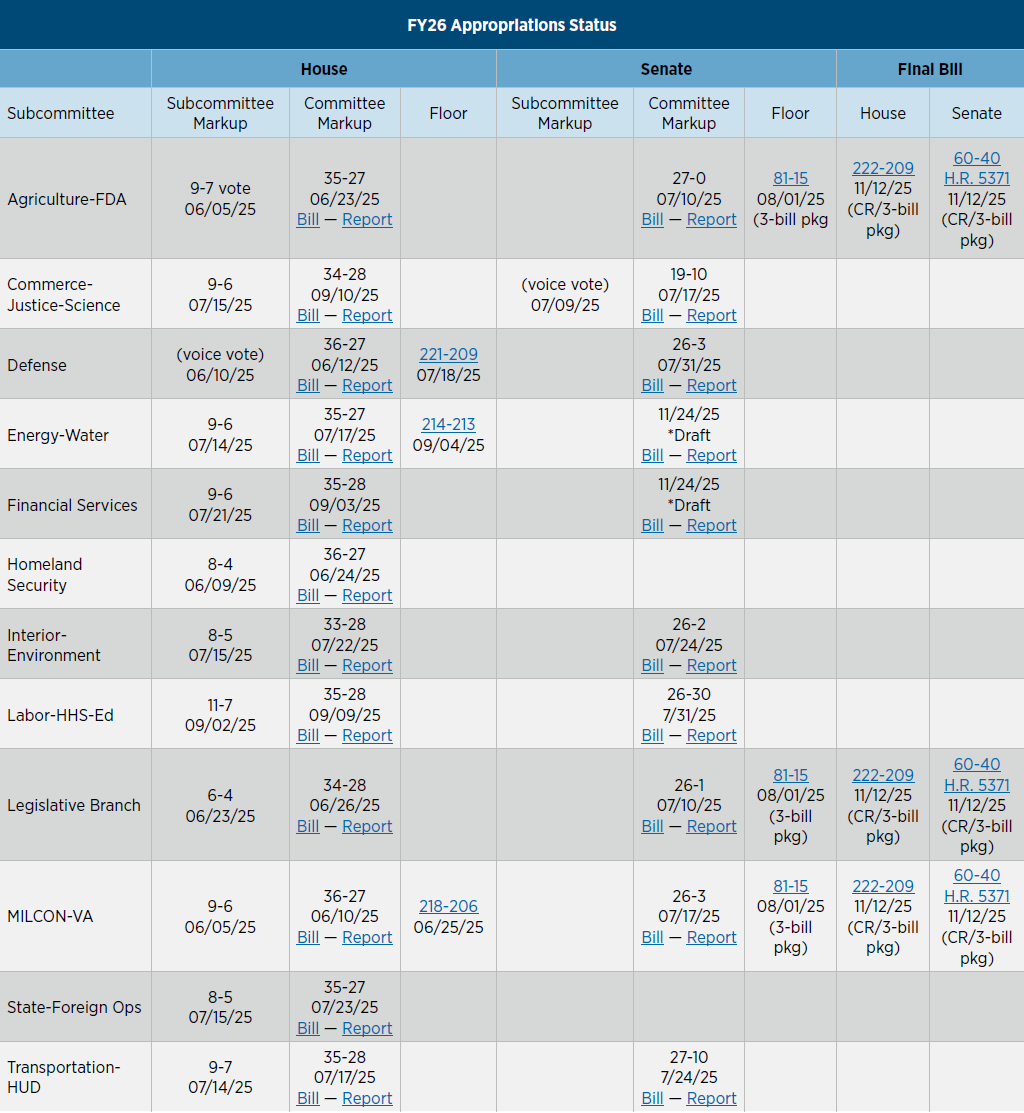
*Senate Committee majority posted draft bill and report without committee action. Chart III. Source: Congress.gov