
December 18, 2025
Congress, not Trump, Will Drive FY26 Civilian Funding Levels

With three appropriations bills done, we have certainty for FY26 discretionary funding levels for the Veterans Administration, most of the Department of Agriculture, the Food and Drug Administration, Military Construction, the Legislative Branch, and other small agencies funded via those spending bills. The three enacted bills account for less than one-fourth of civilian, or “non-defense” discretionary spending, leaving most of the government “TBD.” Looking ahead to the non-defense federal functions currently operating under a Continuing Resolution, what funding can the agencies expect?
For FY26, the Trump Administration seeks lower total civilian discretionary spending. As the Office of Management and Budget summarized in a May 2, 2025, letter accompanying its budget submission to Congress, “The President is proposing base non-defense discretionary budget authority $163 billion–22.6 percent–below current-year spending.” As seen in Chart I, the Trump total for the civilian agencies/ non-security funding is $614.3 billion. Many programs were proposed for elimination and others, such as the Environmental Protection Agency (EPA), were severely cut (the EPA, by more than half). Further, at the time the budget was sent to Congress, there was additional uncertainty since DOGE was still active and its work was not incorporated into the budget presentation.
Congress, through the appropriations process, worked its will on the FY26 Trump Budget and set spending numbers that frame the FY26 likely outcomes. The House Appropriations Committee (HAC) completed work on the 12 appropriations bills from June to September, totaling $720.6 billion in civilian funding, $106 billion over the Trump budget. The Senate Appropriations Committee (SAC) marked up eight of the twelve bills in July, and in November posted the majority position on two of the four remaining bills. The Senate civilian total, with some assumptions for the non-reported bills, is estimated to be about $766 billion, or $150 billion over the Trump budget. With the House 17% and the Senate 25% above the Trump FY26 non-defense discretionary total, expect final tallies to be in that range.
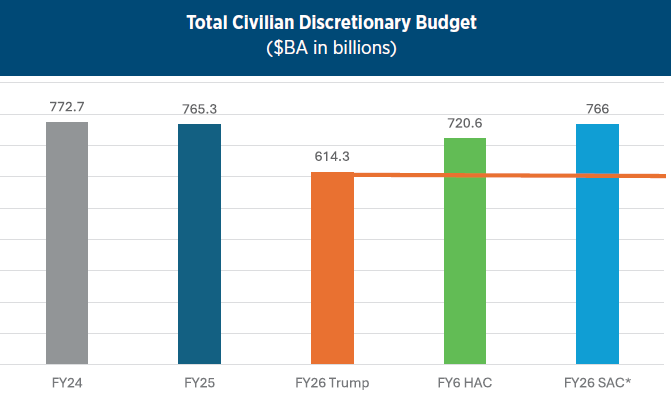
*The Senate Appropriations Committee (SAC) has not acted on all FY26 funding bills; the $766 billion figure is an estimate. Chart I. Source: OMB, CBO, House and Senate Appropriations Committees, FBIQ.
TRUMP, HOUSE, AND SENATE FUNDING LEVELS
Highlights from House and Senate Appropriations committee-reported bills follow. The four bills that have not been reported out of SAC are not included.
Interior-Environment Interior bill totals are likely to fall short of the $43.7 billion provided in FY25, but both the HAC and SAC rejected the Trump cut of $16.8 billion from current levels. Some of the Trump reductions were transfers to other agencies that Congress rejected. The Interior bill spending totals would be $26.5 billion in the Trump budget, $41.7 billion as passed by HAC, and $42.4 billion in the SAC version. While the HAC and SAC kept the Department of the Interior close to FY25 levels, both decreased EPA from FY25 levels (-23% and -5%, respectively), but not the Trump EPA funding decrease of 55%. Both committees maintained related agencies, such as the Forest Service, close to or slightly over FY25 levels.
Commerce, Justice, Science (CJS) The Trump request for FY26 is $67.7 billion, $14.8 billion below the current level. HAC marked their bill at $80.3 billion, and SAC at nearly $83 billion, both close to the $82.5 billion CJS FY25 level. Within the CJS bill, the Senate increased the Department of Commerce by almost 5% over FY25, slightly reduced the Department of Justice from FY25, and provided $33.9 billion for the science agencies (including NASA and National Science Foundation), a $1 million increase over FY25 and $11 billion over the Trump budget. The HAC funded Commerce slightly below FY25, Justice 1% over FY25, or $2 billion over Trump’s FY26 DOJ budget, and science agencies at $31.8 billion, which is 6% below FY25. The HAC and SAC marks will likely be the top and bottom boundaries for determining final FY26 spending levels, rather than the lower Trump budget totals.
Transportation/Housing and Urban Development (HUD) (THUD) Looking at only the discretionary funding in the bill (transportation has a large mandatory funding component), the Trump request is $63.6 billion, while the House marked the THUD bill at $90 billion and the Senate $100 billion. The Department of Transportation Trump budget request is $26.7 billion, a $1.4 billion increase over FY25, while the House is significantly lower at $21.8 billion. The Senate funding level for DOT is close to the Trump budget, at $26.5 billion. That is 5% over the FY25 level, while the House number is nearly 14% under the FY25 level. The $4.7 billion FY26 gap between the House and Senate positions will be challenging to close.
For HUD, the difference between Trump’s FY26 Budget and Congressional action is stark. Trump requested $36.6 billion, a decrease of almost 47% from the FY25 level. Various housing assistance programs were eliminated or proposed to be changed to be run by states. Neither HAC nor SAC accepted these changes. In contrast, both the committees increased HUD over the FY25 levels: The HAC at $67.8 billion, an 11% increase, and the Senate would fund HUD at $73 billion, which is almost 21% over the prior year. The HAC and SAC funding levels are over $5 billion apart.
Labor, Health and Human Services (HHS), and Education (LHHS-Ed) The largest civilian funding subcommittee, LHHS-Ed accounts for about 30% of the discretionary civilian budget. As a driver of funding decisions, we will highlight HHS, which includes the National Institutes of Health, the Administration for Children and Families, and the Centers for Disease Control and Prevention. Much of the HHS funding goes out in grants to researchers, universities and community-service nonprofits, throughout the country. Trump’s FY26 Budget for HHS is $83.1 billion, a $32 billion (28%) decrease from FY25. The HAC-reported bill totals $108 billion, the SAC mark approaches $118 billion, $25 billion and $34 billion respectively over Trump’s FY26 HHS budget. The House action would reduce HHS by $6.9 billion from FY25, while the Senate increases HHS funding by $1.9 billion compared to last year. That is the overall scope of difference, and while a large number, not nearly as daunting given that both bodies rejected most of the Trump budget cuts for HHS.
The House eliminated funding for one agency (Agency for Healthcare Research and Quality), as proposed in the Trump budget, and trimmed nearly every HHS component agency by between 3% and 11%. HAC proposes reducing CDC funding by 24%, while the Trump budget would decrease CDC by 37% ($2.9 billion). In contrast, the SAC mark would trim CDC by just 4%. The overall difference in CDC funding between the HAC and SAC is $1.6 billion.
For NIH, the Trump request of $28.8 billion is a $17.9 billion decrease from the FY25 level. This funding cut would upend a multi-year bipartisan Congressional effort to drive U.S. biomedical advances by doubling the NIH funding level. Predictably, The House and Senate action did not accept the Trump NIH reduction, with the House setting a $46.3 billion level and the Senate $47.1 billion. We expect NIH funding to land close to $47 billion, generally dodging the Trump decreases to NIH’s budget.
OUTLOOK
We expect Congress to reject the substantial 23% Trump budget cut to civilian program funding. Aggregate FY26 civilian discretionary funding will land close to FY25 funding levels, although not for every program, as we saw in the FY25 full-year CR. FY26 funding levels will vary, depending on which of the three end-game scenarios occur: Congress can pass full-year appropriations bills covering the nine remaining subcommittees (giving the House and Senate the most control over programs and Congressionally-directed spending); Congress may split up the remaining bills and pass full-year appropriations for some, while relegating others to another full-year continuing resolution; or there may be a full-year CR for all of the remaining bills. Even in a full-year CR situation, not all funding is on auto-pilot. There are means for Legislative Branch control, and Congress can work its will on funding levels program by program, through scores of anomalies, carve-outs or exceptions.
Challenges with the Trump budget reduction proposals include poorly communicated or constructed ideas, confusion about the effects of DOGE and administration FY25 rescissions at the same time the FY26 budget was being considered, and underestimating Congressional support for popular programs. Several Trump budget proposals seemed rushed. For example, moving rental assistance programs from federal to state control requires authorizing legislation and a focused and intense effort to get buy-in. Eliminating long-standing programs popular with constituents also is a non-starter for most members of Congress. Republicans will want to deliver some budget wins to the Trump Administration, so several programs may be decreased, and others may be discontinued. The bottom line is that there are not the votes to cut civilian agency spending at the levels Trump wants and in the manner proposed. Instead, for programs of interest, check out the HAC and SAC-approved FY26 budgets to estimate the landing spot for FY26 spending levels.