
January 20, 2026
FY26 Appropriations – Progress, But Some Obstacles Remain
The FY26 continuing resolution (PL 119-37) expires on January 30, 2026. After a 43-day government shutdown, and 108 days into the fiscal year, the House and Senate are finally moving forward to complete the FY26 appropriations process—and the Trump Administration appears to be cooperating. So far, three of the bills have been signed into law (Military Construction/VA, Agriculture, and Legislative Branch).
On January 8, 2026, the House passed a three bill “minibus” by a vote of 397-28 containing Commerce-Justice-Science, Energy and Water, and Interior-EPA. The Senate voted 82-15 to pass the bill on January 15. The Trump Administration supports the bill.
On January 14, the House passed a two bill “minibus” containing the Financial Services-General Government and National Security-State bills, by a vote of 341-79. The Senate is expected to take up the bill the week of January 19.
House and Senate Appropriations Committee leadership hope to complete negotiations on the four remaining bills (Defense, Labor-HHS-Education, Transportation-HUD, and Homeland Security) and file the agreement by January 19. With the Senate in recess the week of January 19 and the House scheduled to be in recess the week of January 26, completion of all twelve bills will require considerable cooperation. Numerous hurdles remain, such as military activity in Venezuela, NIH grant authority, and a House Freedom Caucus desire to review earmarks in the remaining bills.
Given the controversy over ICE deployments in Minnesota and other locations, completing the Homeland Security bill has become the most challenging part of this process. Failure may necessitate either a short term or full-year continuing resolution (CR) for the Department of Homeland Security.
The House and Senate Appropriations Committee Chairs, Cole (R-OK) and Collins (R-ME), have reached agreement on a topline for FY26 spending, though it has not been made public. In aggregate, it is expected to total $1.65 trillion, slightly below the current continuing resolution levels.
President Trump’s FY26 Budget proposed to cut non-defense programs by 23% (a cut of $163 billion). He proposed elimination of many programs and deep cuts in others.
Based on the topline FY26 agreement, the three bills that are public law and the five bills that have passed the House and are expected to be sent to the President, Congress has substantially rejected the deep cuts and eliminations in favor of status quo budgets that are either at or slightly below FY25 levels (see Chart I).
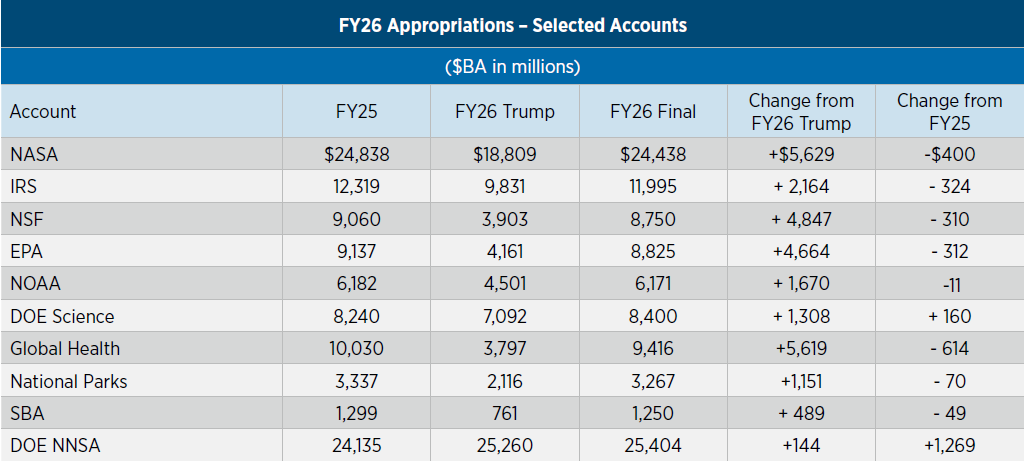
Chart I. Source: House, Senate appropriations committees, OMB
Specifically, Congress rejected deep cuts for NASA, EPA, the National Science Foundation, EPA, the IRS, SBA, and Global Health proposed in Trump’s budget. Eliminations have also been rejected for the Voice of America, Legal Services Corporation, National Endowments for the Arts and Humanities, and Election Security grants.
… our top priority is keeping the government open and operating for the American people.
House Appropriations Committee Ranking Member DeLauro (D-CT),
January 14
The Appropriations Committees have included provisions reasserting Congress’ power of the purse by including bill language that gives detailed spending allocations contained in report language the force of law. This move is in direct response to Office of Management and Budget (OMB)Director Vought’s failure to provide meaningful spending plan data to Congress over the past year.
It will be interesting to see whether OMB complies.
With this flurry of congressional action, a great deal of the uncertainty that characterized calendar year 2025 will hopefully be diminished. That should be good news for federal workers, federal agency managers, and federal contractors.