
While the FY27 appropriations process is underway, few, if any, of the twelve bills will be enacted into law by October 1. The House Appropriations Committee has reported eleven of the twelve bills (all but Defense), but the full House has passed only two — Military Construction-VA and Agriculture-FDA). The Senate Appropriations Committee has yet to report any of the bills.
It is expected that the government will operate under a continuing resolution at FY26 funding levels from October 1 until at least early December. It is unlikely that there will be a government shutdown on October 1. There is no political advantage to either party of a government shutdown five weeks before the mid-term elections.
I think it is safe to conclude that there will not be another reconciliation bill, so it is not really an option.
Sen. McConnell (R-KY),
June 9I agree with that statement.
Sen. Collins (R-ME),
June 9
There are numerous impediments to making progress on the FY27 bills. Congress did not enact a budget resolution for FY27 (the deadline was April 15). Therefore, there is no agreed upon topline for defense and non-defense discretionary spending. Delays are also expected as a result of:
- Uncertainty over the future course, and cost, of the conflict in Iran;
- Absence of an agreement on how to finance significant increases in the cost of Veterans Medical Care;
- Whether/how to address the multi-billion-dollar shortfall in funding the Pell grant program (grants for higher education); and
- The impact of the expiration of the 2021 Infrastructure law (funding expires at the end of FY26 for highways, transit, clean and safe drinking water, cybersecurity, broadband, etc.).
- Uncertainty about whether the Trump Administration intends to unilaterally impound or pocket-rescind funds approved by Congress and signed into law by the President.
The President’s FY27 Budget (submitted in early May) exacerbates the lack of agreement on toplines. The President proposes a 42% increase in national security programs (from $1.058 trillion to $1.504 trillion) and a 10% cut in non-defense programs from $733 billion to $660 billion), including proposed deep cuts in education, housing, public health, foreign assistance, the environment, and science and technology programs (see discussion of Science and Technology programs below). The President proposes that $350 billion of the national security increase be enacted as mandatory funding through the partisan reconciliation process, a controversial process that is unlikely to be completed prior to the election.
While House Republicans are preparing to introduce a third reconciliation bill with the $350 billion of national security spending, Speaker Johnson (R-LA) has indicated that, in an effort to get support from fiscal conservatives, they are also expected to include anti-fraud provisions on the domestic side of the budget. President Trump is also urging Congress to include the contentious Save America Act concerning voter eligibility in reconciliation. Senator Mitch McConnell (R-KY), Chair, Defense Subcommittee of the Senate Appropriations Committee and Senator Susan Collins (R-ME) Chair, Senate Appropriations Committee, have raised concerns about using the reconciliation process to provide $350 billion for national security.
Further complicating progress on the FY27 bills are recent actions by the President. His effort to establish a $1.8 billion so-called anti-weaponization fund that would pay people who have “suffered weaponization and lawfare” at the hands of the federal government such as convicted and pardoned attackers at the U.S. Capitol on Jan. 6, 2021, has proven controversial on both sides of the aisle. While the Acting Attorney General Todd Blanche has testified that the Administration no longer intends to make such payments, Senate Minority Leader Schumer (D-NY) introduced legislation barring the fund for such use June 16.
Similarly, efforts to fund the controversial White House ballroom project through reconciliation were dropped from the Secure America reconciliation bill before the President signed it. White House plans to use over $300 million in taxpayer funds for the ballroom that were appropriated to the US Secret Service in the One Big Beautiful Bill Act will further undermine the ability of the Senate to move forward on a bipartisan basis.
As a result of all this uncertainty, Senate Appropriations Committee Chair Susan Collins has delayed the FY27 mark ups until June 25. Topline discussions with Vice Chair Murray (D-WA) continue. In recent years, when there has been no topline agreement, the Committee has simply made the bills/reports public without marking them up. While Chair Collins has not made that decision, it is an option for July. However, completion of FY27 appropriations bills ultimately will require bipartisan cooperation to avoid a Democratic filibuster in the Senate.
[Senator Collins], “continues to propose topline funding levels that would supersize Trump’s war budget while leaving families behind.”
Senate Appropriations Committee Vice Chair Murray (D-WA),
June 15
SCIENCE AND TECHNOLOGY FUNDING
In the FY26 appropriations bills, Congress reduced the size of President Trump’s proposed steep cuts in science and technology programs across the government, however some cuts were enacted. That pattern is being repeated in the FY27 House bills (see Chart I). In that the Senate has not yet marked up any bills, it is unclear the extent to which these cuts will once again be reduced.
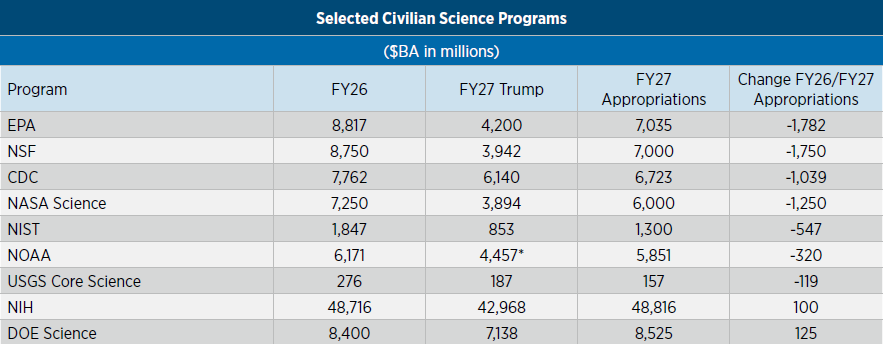
* Request figure for NOAA is based on the Commerce Department budget documents and differs from CRS estimates of the request which includes transfer of funds from National Marine Fisheries/Promotion and Development and finance adjustments, bringing the total to $4.97 billion. Chart I. Sources: HAC Committee reports and President’s FY27 Budget