
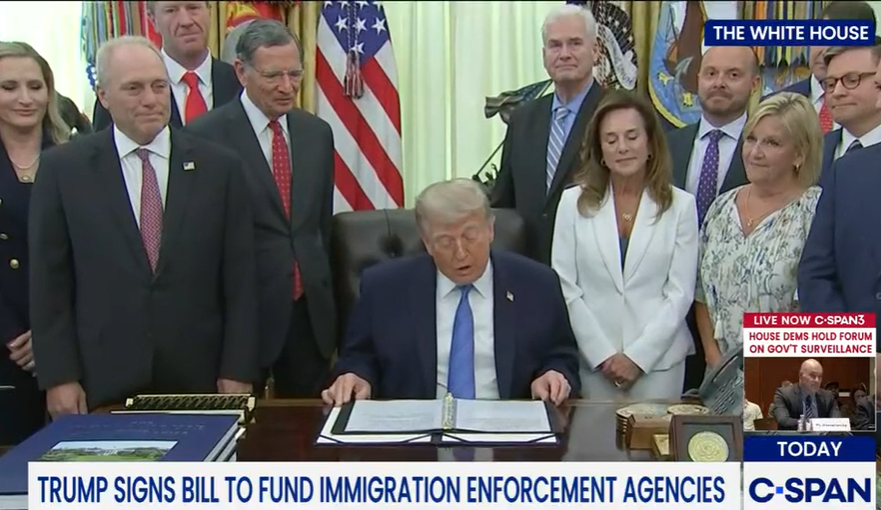
On June 10, President Trump signed the Secure America Act, a budget reconciliation bill providing mandatory funding for the Department of Homeland Security’s (DHS) Border Patrol and Immigration and Customs Enforcement (ICE) agencies through FY29.
This morning, I’m thrilled to sign the Secure America Act to immediately and fully fund the Department of Homeland Security through the end of my term…
President Trump,
June 10
RECONCILIATION BORDER PATROL AND ICE FUNDING
Reconciliation was first used to fund discretionary programs in 2021 with the enactment of the American Rescue Plan Act, which also included changes to tax laws and mandatory spending. The same was done in the 2022 Inflation Reduction Act and the One Big Beautiful Bill Act of 2025 (OBBBA). All three of these bills were enacted when the same party controlled the White House and the Congress and were passed largely on party-line votes. Unlike previous reconciliation bills, these bills also included mandatory funding to supplement what was traditionally provided as discretionary funding in the bipartisan appropriations process. In the case of the OBBBA, it included roughly $150 billion in mandatory funding for CBP, ICE, and DHS border security purposes.
The Secure America Act differs from those earlier bills in that it not just augments but replaces funding traditionally provided through the bipartisan appropriations process for both the Border Patrol and ICE. Unlike appropriations bills, which mostly provide annual funding for agencies, the Secure America Act provides FY26 appropriations designed to cover the three remaining years of the Trump Administration (FY26-FY29). Due to rules limiting reconciliation to just budget provisions, the bill also doesn’t include the detailed directives typical of appropriations bills and their supporting materials.
The Secure Act provides funding divided between those programs in the Homeland Security Committee’s jurisdiction (Title I) and the Judiciary Committee’s jurisdiction (Title II). Chart I displays the appropriations (budget authority) provided in the Act by DHS agency along with the Congressional Budget Office’s estimates of the outlays (expenditures) that will result for FY26-35.

Chart I. Source: CBO, FBIQ. * = between zero and $500,000.
CUSTOMS AND BORDER PROTECTION (CBP) MANDATORY FUNDING
The Act provides a total of $26.0 billion to CBP in FY26 to remain available through FY29.
Section 101 provides $9.55 billion and section 201 provides $13.02 billion to CBP to hire, pay, train, and equip CBP personnel. Section 103(a) provides $3.45 billion for:
- Procurement and integration of inspection technologies to combat illicit narcotics at the borders;
- Air and Marine operations upgrades and procurement;
- Upgrade and procurement of border surveillance technologies;
- Biometric entry and exit technologies;
- Combating drug trafficking at the borders; and
- Other necessary CBP expenses not related to customs and immigration
Section 103 (b) includes a restriction that none of the funds can be used for the procurement or deployment of surveillance towers with autonomous capabilities at the border unless inspected and accepted by CBP.
IMMIGRATION AND CUSTOMS ENFORCEMENT (ICE) MANDATORY FUNDING
The Act provides a total of $38.5 billion to ICE through the following sections.
Section 102 provides $7.45 billion to hire, pay, train, and equip, along with other necessary expenses, for Homeland Security Investigations’ mission support, operations, and maintenance. Of that amount, it allocates $108.5 million to hire, pay, train and equip additional child exploitation investigators and forensics analysts with a restriction that the funds only be used for activities other than customs and immigration enforcement.
Section 202 provides $31.1 billion for the following:
- To hire, pay, train, and equip ICE personnel to carry out immigration enforcement activities;
- Transportation and related costs associated with alien departure or removal operations;
- Information technologies maintenance and sustainment to support enforcement and removal operations;
- Facility maintenance and sustainment to support enforcement and removal operations;
- Fleet maintenance to support enforcement and removal operations;
- Supporting coordination with state and local governments through section 287(g) agreements;
- Hiring and paying attorneys in the Office of the Principal Legal Advisor to represent DHS in immigration enforcement and removal proceedings;
- Operations and enforcement, including awards, for immigration enforcement operations; and
- $350 million for detainer management, detainer issuance, custodial transfer, release monitoring, transportation, and arrests of unlawful aliens encountered in state and local jurisdictions that are not qualified cooperating jurisdictions.
OTHER DHS MANDATORY FUNDING
Sections 104 and 203 each provide appropriations of $2.5 billion (for a total of $5 billion) to the Secretary of Homeland Security. Section 104 makes the funds available for the purposes provided in the Homeland Security Title of the Act. Section 203 makes the funds available for the purposes of the Judiciary Title of the Act or for purposes specified in the One Big Beautiful Bill Act (personnel assignments to carry out immigration enforcement and state and local participation in homeland security efforts).
ESTIMATED OBLIGATION AND EXPENDITURE OF SECURE ACT FUNDING
While the Act provided $26 billion to Customs and Border Protection (CBP), $38.5 billion to Immigration and Customs Enforcement, and $5 billion for the Secretary of the Department of Homeland Security in FY26, the funds are available for obligation through FY29. Since the clear intent is to fund these two agencies through the end of the Trump Administration, DHS is likely to obligate these funds to cover operations and other needs over the next four years. Funding for personnel and operation and maintenance will be obligated and expended rapidly, while procurement and grant programs are likely to see lags in the obligation and expenditure of funds. Chart II displays the pace these funds will be spent based on Congressional Budget Office’s estimates of outlays (expenditures) by each of the two agencies (CBP and ICE) as well as the appropriations to the Secretary of Homeland Security. Bear in mind that signed contracts and grant agreements constitute the point of obligation and that happens before outlays, which are a lagging indicator.
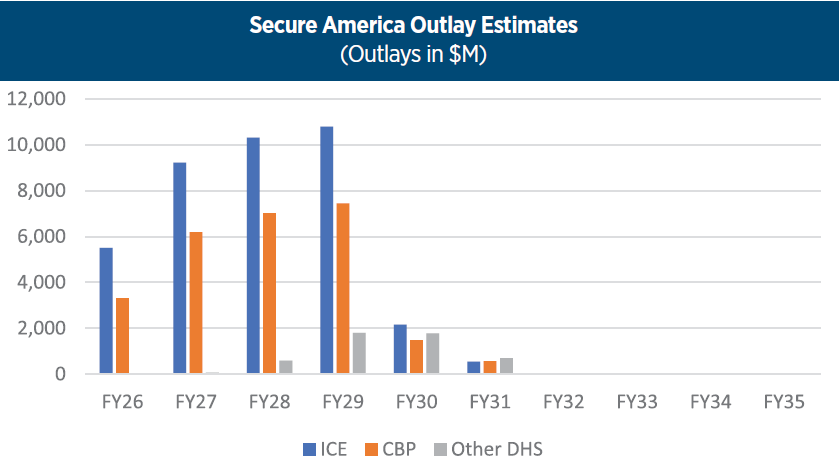
Chart I. Source: Congressional Budget Office
A LONG AND STRANGE TRIP
Congress always struggles to complete the annual appropriations process, but the FY26 appropriations process was particularly arduous. It started with a government shutdown of all agencies funded with appropriations and ended with a reconciliation bill funding two agencies, Border Patrol and ICE, through a multi-year reconciliation bill providing mandatory appropriations. The process was side-tracked by a series of controversies, including the expiration of health care (“Obamacare”) tax subsidies, ICE enforcement actions and protestors’ deaths in Minnesota, a $1 billion Secret Service proposal that included funding for the President’s ballroom project, and a $1.8 billion “Anti-Weaponization” Fund. The Senate ultimately dropped all Secret Service funding from the reconciliation bill, the Justice Department abandoned the “Anti-Weaponization” Fund and the bill passed both the Senate and House on largely party-line votes.
With enactment of the Secure America Act, Congress has completed the FY26 process of funding agencies traditionally funded in the 12 appropriations bills. The FY26 appropriations process is emblematic of the increasing partisan tensions that have hamstrung the traditional bipartisan appropriations process, and that is evident in the struggles the Senate is having in moving its FY27 appropriations bills. When there is unified government, the party in control has increasingly used the reconciliation process to fund programs traditionally funded through the appropriations process, an outcome that even Republican members who have supported reconciliation lament.
I hate that we are having to use reconciliation to do this, but we have no other choice. Plenty of us were willing to work with the appropriations process to reform Border Patrol and ICE, but that didn’t work.
Senate Budget Committee, State & Foreign Operations Appropriations Subcommittee Chair Graham (R-SC),
June 4
RECONCILIATION 3.0
Republicans have an option to trigger a third reconciliation bill via the adoption of an FY27 budget resolution. House Budget Committee Chairman Jodey Arrington (R-TX) has been an advocate for a broad third reconciliation bill that would boost defense funding and include “anti-fraud” reforms.
Senate Republicans are more dubious about a third reconciliation bill, with Appropriations Chair Susan Collins (R-ME) expressing skepticism of a third reconciliation bill getting done to fund the $350 billion of the Administrations proposed FY27 DOD increase. Senate Majority Leader Thune (R-SD) also has expressed reservations but has been careful not to rule out a third reconciliation bill.
There has to be a specific reason for doing it [reconciliation]… [I’m] open to it but also recognizing it has some serious challenges ahead of it if we get another reconciliation bill on the floor of the Senate.
Senate Majority Leader Thune (R-SD),
June 9
Despite these reservations, the President has since called for a third reconciliation bill to include $350 billion of his proposed $1.5 trillion DOD budget request, along with a bill to tighten voting eligibility.
Reconciliation 3.0 is a long shot at this stage. The House, the Senate, and the White House are not on the same page. Yet, reconciliation remains a powerful option at their disposal and the chances of it getting deployed will increase if Congress gets dead-locked on a must-do budget item.
As the experience with reconciliation 2.0 demonstrated, however, to garner the Republican votes in the Senate to pass a third reconciliation bill, it will need to be narrow and targeted. As one possible option, if DOD gets ensnared in another government shutdown or runs into operational problems due to the Iran War and the need for supplemental appropriations, reconciliation could become an option to get funding enacted over congressional Democratic opposition.