
On June 5, the House Armed Services Committee (HASC) voted 44-12 to adopt the FY27 National Defense Authorization Act (NDAA). The Senate Armed Services Committee (SASC) followed six days later and passed its version by a vote of 18-9. Historically, the Armed Services Committees have passed NDAA’s that have numbers associated with them as an authorized level or amount, but the Department of Defense (DOD) looks to the committees more for policy guidance than funding. Actual funding is traditionally the responsibility of the appropriations committees. That changed last year when the One Big Beautiful Bill Act (OBBBA) passed and provided just over $150 billion to the Department not as an appropriation, but as direct (mandatory) spending in a reconciliation bill. The President’s FY27 budget requests $350 billion in direct spending again this year.
The HASC matched the President’s FY27 discretionary request for the Department of Defense (051) at just over a trillion dollars ($1.1 trillion). The Senate, which released the bill text and summary June 16, would also fund DOD at an overall discretionary level of $1.1 trillion, consistent with both the President’s request and the HASC reported bill.
Importantly, however, neither the HASC nor the SASC address the President’s $350 billion mandatory request, choosing to focus on discretionary targets. As a result, the NDAA is silent on the funding for initiatives such as Golden Dome which is funded almost entirely in the mandatory portion of the request. This leaves the Pentagon with a tremendous hole in funding for some of the President’s highest priorities. While there have been discussions regarding a supplemental war bill and a third reconciliation bill, the Congress is far from unified behind either one of these strategies and as the number of legislative days prior to the election dwindle, filling the funding gap prior to the end of the fiscal year becomes doubtful.
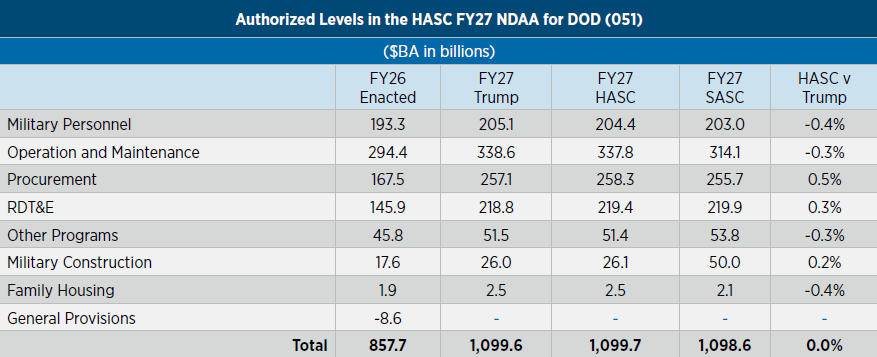
Chart I. Source: House, Senate Armed Services Committees, Appropriation Committees, Department of Defense
MILITARY PAY RAISE
The FY27 HASC NDAA echoes the President’s request of a pay raise of 5-7% for military personnel depending on rank with the higher 7% raise being reserved for E-1 to E-5, the 6% for E-6 to O-3, and the 5% for O-4 and above. The Senate does not use a tiered system and instead authorizes a flat 3.6% increase in pay for military personnel. Neither bill includes a pay raise for civilian personnel. Changes in pay can affect the degree to which DOD has military personnel, DOD civilians, or contractors perform work.
ROBOTICS AND AUTONOMOUS SYSTEMS COMBATANT COMMAND
Technology changes drive the evolution of warfighting and the military action in Ukraine, the Middle East, and South America provide a real-world laboratory for new concepts of operations for autonomous vehicles. The Pentagon is wrestling with how best to address these new realities. The Replicator program’s recent shift to the Army’s Joint Interagency Task Force 401 indicates that the Pentagon’s autonomous efforts are still evolving. The Senate’s NDAA provides the Pentagon the option to create a new combatant command (COCOM) — the Robotics and Autonomous Systems Combatant Command to help streamline delivery of capabilities while also providing expedited acquisitions. The HASC does not provide the same language so whether this provision makes it into the final bill will be determined in conference.
CYBER, INFORMATION, AND NETWORKS
In addition to encouraging a new COCOM for Robotics and Autonomous Systems, the SASC directs DOD to create a new position that is an Undersecretary for Cyber, Information, and Networks that will also serve as the Department’s Chief Information Officer (CIO) and the Principal Cyber Advisor (PCA) to the Secretary of Defense. This is being done to ensure conflicts between the CIO and the PCA are resolved internally since the CIO’s protect-and-defend activities sometimes reportedly conflict with CYBERCOM’s activities. This position will also oversee the Chief Digital and Artificial Intelligence Office (CDAO) to ensure the alignment of AI technologies within cyber operations. The HASC recognizes the issue of tension between cyber and IT, and while not directing DOD to create a new position, does encourage DOD to review and reorganize as necessary.
WHAT’S AHEAD?
As mentioned above, the President’s request placed many of his priorities into the reconciliation process. The tradeoff between oversight and certainty is now playing out as Congress considers its options and whether to backfill some of those priorities through the more rigorous appropriations process. Regardless of what the Congress decides, the final impact of that decision will not, in all likelihood, be realized until a lame duck session after the election in November.