
Congress’ ability to legislate via the normal process has been derailed by intense partisan divisions. Those tensions produced a 43-day government shutdown at the end of 2025 due to a dispute over the extension of Obamacare health care subsidies and the shutdown of the Department of Homeland Security operations that began February 13 over objections to immigration enforcement actions in Minneapolis. Both of these shutdowns occurred when Senate Democrats filibustered appropriations legislation. Republicans were unable to garner the 60 votes necessary to break the filibusters while Democrats lacked the votes to amend the bills and achieve their goals.
On January 13, the House Republican Study Committee, the largest of the Republican caucuses, released a “Reconciliation 2.0 Framework” focused on “affordability” through proposed housing, health care, and energy policies.
Reconciliation 2.0: the most powerful and potent legislative tool in the toolbox for us to fix what’s broken.
House Budget Committee Chairman Arrington (R-TX), January 13
While House Speaker Johnson (R-LA) and Senate Budget Committee Chairman Graham (R-SC) spoke last year in support of pursuing another reconciliation bill, that option currently faces at least two major obstacles. Due to two Republican vacancies, House Republican leadership can only afford to lose one of their members on a party-line vote and they usually start a vote down since Rep Massie (R-KY) frequently does not vote with the caucus. Second, unlike last year’s One Big Beautiful Bill Act (OBBBA), there is no consensus on what a reconciliation bill should contain. President Trump also recently appeared to pour cold water on pursuing another reconciliation bill.
While Republicans do not appear to be pursuing a reconciliation strategy currently, it remains a powerful option. Since Congress did not adopt a budget resolution for FY26 last year, Republicans have the option of generating two reconciliation bills this year: one via a FY26 budget resolution and another one via a FY27 budget resolution.
And so in theory, we’ve gotten everything passed that we need. Now we just have to manage it, but we’ve gotten everything passed that we need for four years.
President Trump, February 10
RECENT USE OF RECONCILIATION
On July 4, 2025, President Trump signed OBBBA into law, a partisan bill that was enacted through the budget reconciliation process. That 330-page law made major changes to the Federal budget including the permanent extension of 2015 tax cuts scheduled to expire at the end of 2025, the addition of new tax cuts, $153 billion in mandatory funding for the Department of Defense (DOD), $191 billion in mandatory funding for the Department of Homeland Security (DHS), changes to public assistance and student lending programs that reduced spending, and a $5 trillion increase in the debt limit. Relative to a current law baseline over 10 years, the bill was estimated to reduce Federal revenues by $4.5 trillion, lead to a net $1.1 trillion reduction in federal spending, and a $3.4 trillion increase in the deficit.
Although a time-consuming and complicated process, reconciliation provides the majority with the ability to combine a multi-committee legislative package into one filibuster-proof bill that can be driven through the Senate via a simple majority vote. Both parties have used the process to enact major budget legislation and have completed that process in as little as 5 weeks (see Chart I below listing recent use of the reconciliation process). At the end of 2021, for example, Senator Manchin’s opposition to the Build Back Better reconciliation act seemed to be its end but that reconciliation bill was rewritten to become the Inflation Reduction Act and was enacted eight months later with only Democratic votes, a year when the country had a mid-term election, inflation was a top concern for voters. Republicans narrowly took back control of the House and broke Democratic unified control of government in the 2022 mid-term elections.
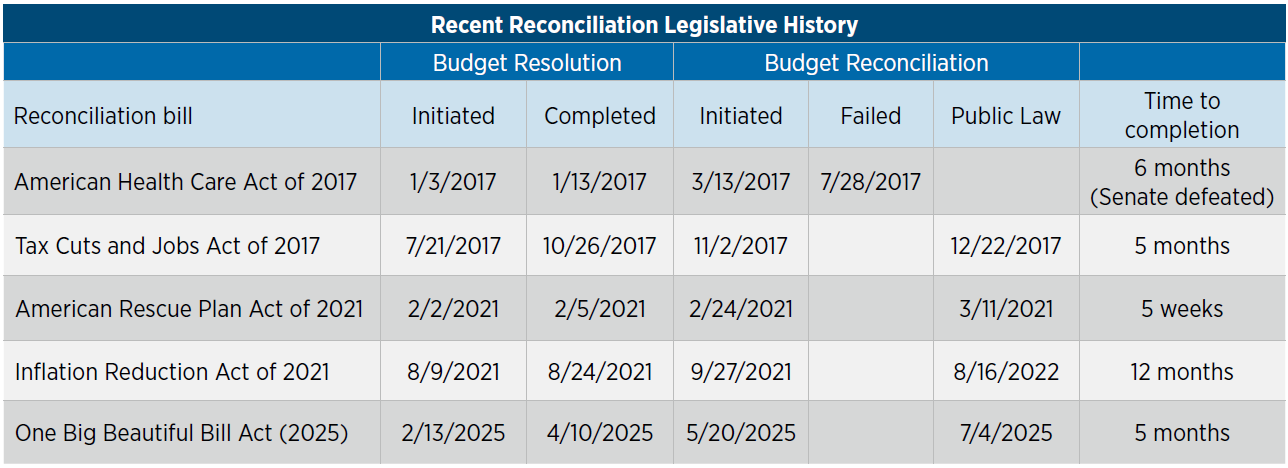
Chart I, Source: FBIQ
DEFENSE BUDGET AND RECONCILIATION
On January 7, President Trump stated that his FY27 budget would include $1.5 trillion for the defense budget to build a “dream military,” a $450-600 billion increase. FY26 appropriations bills provided just under $860 billion for the Department of Defense (DOD). Other bills fund additional defense activities, particularly at the Department of Energy. OBBBA provided another $156 billion in one-time FY25 mandatory defense funding, of which about $153 billion goes to DOD. To meet the President’s FY27 target, the appropriations committee would need to increase the defense budget by at least $600 billion. It is highly unlikely that Senate Democrats would allow a defense appropriations bill with a more than 50% increase to clear the Senate. In the past, they have demanded “parity” between defense and non-defense appropriations increases and have usually held up the defense appropriations bill until domestic bills were also finalized (particularly the Labor HHS appropriations bill). And as in the case noted above, this is another mid-term election year but with Republican majorities at risk this time.
Reconciliation provides Republicans a filibuster-proof avenue to secure a large defense increase without Democratic support. Over the past six weeks, support for a second reconciliation bill has waned. Other reconciliation options under discussion include addressing “affordability” through policies to address health care, housing, and energy costs. Since the Supreme Court invalidated a significant portion of the President’s tariffs, Congress could legislate a tariff increase, which could be scored as raising revenue to offset the deficit impact of other provisions of a potential reconciliation bill. Those two items could be combined with a defense spending increase in a second bill. That seems highly unlikely at this stage, but events could change the odds.
The next step will be to see what the President calls for in his February 24 State of the Union address, his FY27 budget request, and the details of his defense budget proposals.
Reconciliation Primer
- Congress must first adopt a budget resolution to trigger the reconciliation process.
- The budget resolution must include reconciliation instructions to authorizing committees who subsequently report legislation making changes in budgetary levels for programs in their jurisdiction to the budget committees, which then combines those submissions into an omnibus reconciliation bill.
- Reconciliation bills are considered under time and other limits and cannot be filibustered in the Senate.
- The Senate’s Byrd rule limits reconciliation bills to budgetary provisions. As a result, reconciliation bills are limited to provisions that increase or decrease mandatory spending, revenues, or the debt limit.