
February 25, 2026
Final and Steady: FY26 Health and Human Services Funding Outlook

Funding covering the Departments of Labor, Health and Human Services (HHS), and Education was enacted as part of the latest (and largest) FY26 spending package, P.L. 119-75, signed on February 3. One of the five bills included in that package, the L-HHS-Ed bill is the largest non-defense spending bill, accounting for about $198 billion in discretionary funding and over $1 trillion in mandatory funding. Both the Senate and House Appropriations Committees approved the L-HHS-Ed bill: the Senate did so in July and the House in September. Neither the full House nor Senate took up the bill on the floor, but between December and January, it was conferenced between the four corners to come to agreement on funding, oversight, and policy issues. As with any compromise, neither side got all it wanted. Total funding settled close to FY25 levels, higher than House Republicans wanted, but shy of the Senate numbers. Existing, long-standing policy riders were continued, and additional oversight provisions were added in the final legislation.
This is what responsible governance looks like. This measure is the product of sustained engagement and serious legislating. It advances reforms, delivers full-year funding, and reflects a Congress doing its job.
House Appropriations Chair Cole, R-OK, Jan. 22
HHS INVESTMENTS IN BIOMEDICAL RESEARCH AND HEALTH
Our focus is on the HHS title of the L-HHS-Ed bill. HHS is the largest department in the bill, an innovation driver, and a major national grantmaking entity, funding states, localities, universities and nonprofits for health-related research and social services. Agencies in HHS include the National Institutes of Health (NIH), the Centers for Disease Control and Prevention (CDC), the Health Resources and Services Administration (HRSA), the Substance Abuse and Mental Health Services Administration (SAMHSA), the Administration for Children and Families (ACF), the Agency for Community Living (ACL), program management and technology for Centers for Medicare and Medicaid Services (CMS), emergency preparedness under the Administration for Strategic Preparedness and Response (ASPR), and others.
Because the Food and Drug Administration, while part of HHS, is funded by the Agriculture bill, requirements described here will not apply to it. Details by agency are shown in Chart I on page 6. Budget data is derived from the Explanatory Statement posted in the January 22, 2026, Congressional Record and budget tables included in H. Rpt. 119-271, filed September 11, 2025.
HHS total FY26 discretionary funding is nearly $115 billion, essentially flat from FY25 levels, but 38% (+$31.5 billion) over the Trump FY26 budget plan for HHS. Within the $115 billion total, Congress added over $900 million in funding for congressionally-directed projects in HHS agencies which are listed in the Explanatory Statement.
This bill prioritizes funding to help make Americans healthier and supports lifesaving biomedical research, including through targeted funding for Alzheimer’s, cancer, Lyme disease, Parkinson’s, ALS, diabetes, and rare disease research. It also provides significant resources for substance use prevention and treatment programs…
Senate Appropriations Chair Collins (R-ME), Feb. 3
CONGRESS REVERSES MOST TRUMP BUDGET CUTS
The Trump Administration FY26 budget proposed cutting HHS funding from $115 billion in FY25 to $83 billion, a decrease of $32 billion, or about 30% below FY25. By agency, the Trump cuts would have ranged from -2% to -100% (eliminating funding for the Agency for Healthcare Research and Quality (AHRQ)). While Congress rejected the severe cuts, several operating divisions are funded below FY25 levels. The CDC is cut by $230 million or 3% below FY25, the Administration for Children and Families funding is decreased by $934 million, or 3%, and AHRQ is cut by $24 million, a 6% decrease from FY25.
As seen in Chart I, most operating divisions held steady from FY25 to FY26. HRSA is an outlier, increasing 12% over the FY25 level and 47% more than Trump’s FY26 Budget. Part of the increase goes toward Congressionally directed spending within that agency. CDC, while slightly under its FY25 funding level, is 53% over the Trump FY26 proposal. The National Institutes of Health are funded at $47 billion, just 1% over their FY25 funding level, but that is 63% above the Trump NIH budget of $28.8 billion. Other agencies were similarly restored to FY25 levels and Trump cuts denied. Congress did not eliminate AHRQ and provided $345 million rather than zeroing out its budget. The Trump budget requested an increase in funding for the Office of the Secretary, which was partially provided.
Within NIH, the National Cancer Institute is funded at close to $7.4 billion, the Advanced Research Projects Agency for Health (ARPA-H) is provided $1.5 billion (same as FY25), and the National Institute of Allergy and Infectious Diseases (NIAID) is funded at $6.6 billion.
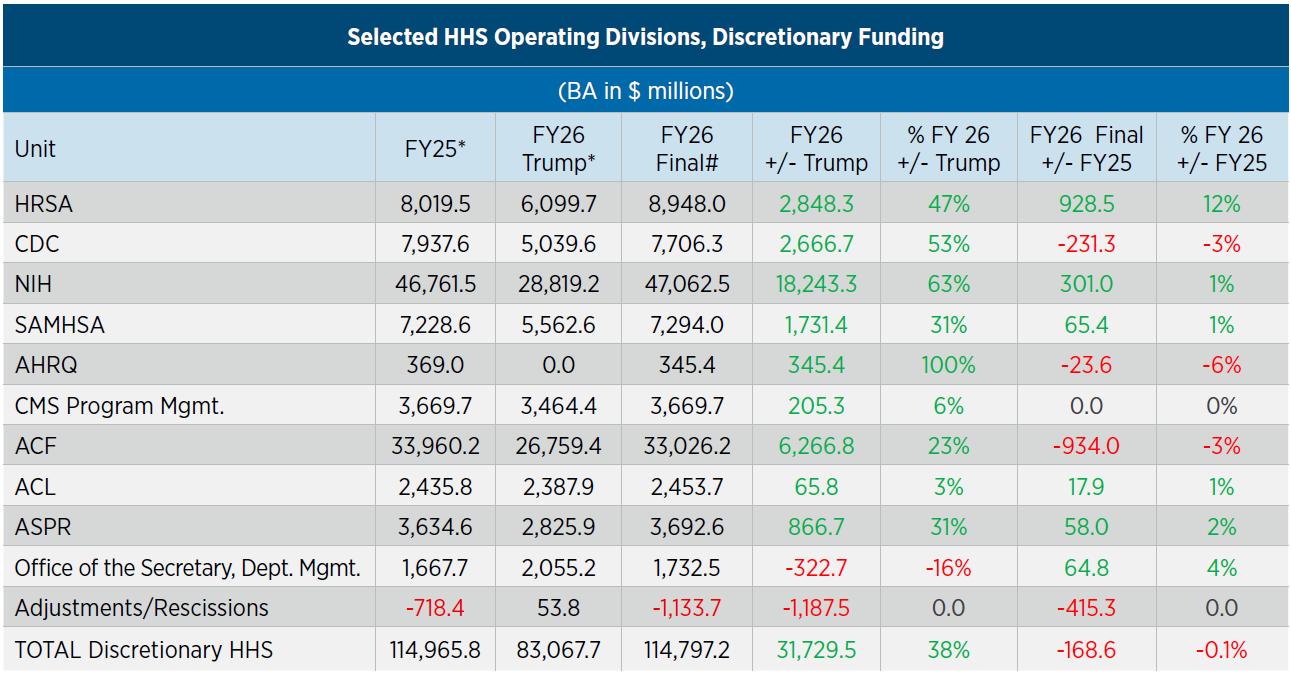
Note: Discretionary funding only; does not include Program Integrity, CURES Act, emergency or transfer funds. Chart I. Sources: *H. Rpt. 119-271, # Explanatory Statement, 1/22/2026 Congressional Record
INFORMATION TECHNOLOGY INVESTMENTS
House and Senate directives regarding IT, such as instructions on cybersecurity or adoption of artificial intelligence, covered by FBIQ in September 2025, were largely included in the final funding agreement unless specifically changed in the Explanatory Statement.
The Office of the National Coordinator for Health Information Technology is provided $3 million for standards development with industry that prioritize interoperability, patient safety, and patient privacy, and $5 million to support interoperability and information sharing efforts related to past healthcare interoperability standards.
The funding bill includes $185 million to support Public Health Data Modernization at CDC, a multi-year investment to modernize enterprise-level public health data systems at CDC and state and local partners and requires a detailed funding and operations briefing in 90 days.
STRENGTHENED OVERSIGHT
Congress’ “power of the purse” is addressed with new requirements on the Executive Branch and tightened restrictions on changes to spending. Language is included in the bill and Explanatory Statement with the intention of safeguarding funding to agencies, and ensuring it is allocated to the purposes Congress has set, in the amounts it has set, and in the timeframe expected—and further, to not have the administration withhold funding Congress has provided. The L-HHS-Ed legislative text and statement include the following requirements:
- Each Department and agency funded in this Act shall follow the directives set forth in this Act and the accompanying explanatory statement.
- No reallocations of resources or reorganization activities unless directed.
- Detailed tables and funding instructions within the Explanatory Statement must be followed.
- Any action to eliminate or consolidate programs, projects, and activities should be pursued through a proposal in the President’s Budget.
- Each Department or agency must provide an operating plan and monthly report on funds that are allotted and available for obligation, and obligations made, by program, project, and activity.
- Restriction on moving or reorganization of CDC or its functions without notice and independent review.
STAFFING CUTS AND REORGANIZATION
The administration announced in April 2025 that it would cut 20,000 positions across HHS. While it did not identify savings from those cuts, or contracts needed to replace functions that the staff performed, expect Congress to focus on these issues in upcoming FY27 budget hearings. Reorganizations, such as centralizing Human Resources, Information Technology and Procurement, will also be assessed and HHS leaders questioned about their plans and actions.
In an attempt to protect HHS employees, the FY26 appropriations law includes a provision directing HHS to “support staffing levels necessary to fulfill its statutory responsibilities including carrying out programs, projects, and activities funded in this title of this Act in a timely manner.” This one provision in law, applicable to all operating divisions in the Department, will get a lot of attention and oversight. The language’s lack of specificity will no doubt lead to debates about definitions of statutory responsibilities, timeliness, and use of contractors for government functions, and differences between the actions of various operating divisions will become apparent.
SPRING OUTLOOK AND ASSESSMENT
This bill is critically important to communities, grantees, biomedical research, public health and social services nationwide. After a rough season, finally the appropriations process worked, with rational trade-offs and compromises, and HHS can confidently plan its procurements for the year. In this bill, Congress asserted its role in providing funds versus the full-year continuing resolution that left it irrelevant in FY25. The appropriators bridged a $9 billion funding gap between the House and Senate numbers, united against 30% cuts sought by the Trump Administration, avoided controversial new policy riders, and included additional oversight mechanisms in the bill.
Expect Congressional Democrats to ask tough questions during upcoming Appropriations Committees hearings on the effects of staffing cuts, reassignments, consolidation, and program terminations. Adding spice to that, the government’s sometimes abrupt cancellation of grants to communities, universities, and non-profits have put communities on edge and Members of Congress on alert. With a full year under its belt, the administration has no excuse but to provide required FY26 operating and spend plans on time and a detailed, complete FY27 congressional budget justification for Congress to consider.