
April 20, 2026
Reconciliation 2.0: Funding the Department of Homeland Security

On April 1, President Trump, Senate Majority Leader Thune (R-SD), and House Speaker Johnson (R-LA) all embraced a plan to end the shutdown of the Department of Homeland Security (DHS), the department now holds the record for the longest lapse in appropriations.
The current strategy for resolving this impasse backed by President Trump, the Speaker and the Senate Majority Leader, involves funding DHS through two legislative vehicles, with the Customs and Border Protection and U.S. Immigration and Customs Enforcement (ICE) agencies being funded in FY26 and possibly through FY28 via a reconciliation bill and with the remainder of DHS being funded for FY26 via the Department of Homeland Security FY26 appropriations bill.
I am asking that the [reconciliation] Bill be on my desk NO LATER than June 1st.
President Trump post, April 1
SENATE DEMOCRATIC FILIBUSTER OF CBP AND ICE FUNDING
DHS and other government agencies endured a 43-day shutdown last fall. By early February, Congress completed action on all FY26 Appropriations except DHS. Since a short-term continuing resolution (CR) expired on February 13th, a Senate Democratic filibuster focused on objections to ICE enforcement actions in Minnesota and elsewhere forced a DHS shutdown.
Congressional Republicans tried to move the initially bipartisan DHS appropriations bill, but Senate Democrats filibustered it and subsequent efforts to extend CR funding for DHS, unless their demands were met to place restrictions on ICE enforcement actions. On March 27, Senator Thune broke the stalemate by dropping funding for Border Security and ICE from the DHS bill and sending it to the House. The House initially opposed this approach, but Speaker Johnson eventually embraced it when Thune proposed to fund the Border Security and ICE through reconciliation and the President embraced the plan.
CHALLENGES TO EXECUTING THE REPUBLICAN DHS FUNDING PLAN
The first government shutdown ended with Democrats being divided on the strategy of reopening the government. In the case of the shutdown of DHS, Republicans have been divided, with House Speaker Johnson insisting that the DHS appropriations bill include funding for CBP and ICE and publicly criticizing the Senate’s approach. He reversed his position to the dismay of many of his Republican colleagues, who do not want to vote for a DHS bill that excludes funding for the Border Security and ICE. The House Freedom Caucus and House Budget Chairman Arrington (R-TX) have proposed that reconciliation be used to fund the entire Department for the remainder of Trump’s term.
Chart I outlines two possible options for funding DHS through reconciliation. The first option embraced by the President, Thune, and Johnson would fund just Border Security and the U.S. Immigration and Customs Enforcement (ICE) agencies for FY26 and possibly through FY28. The second option, proposed by the House Freedom Caucus, would fund the entire department through reconciliation for the remainder of the President’s term.
If Republicans decided to fund these two agencies for FY27 and FY28, the chart shows FY27 levels included in President Trump’s FY27 budget request that could be extend through FY28. Both CBP and ICE received a total of $140 billion in additional funding in the 2025 One Big Beautiful Bill Act.
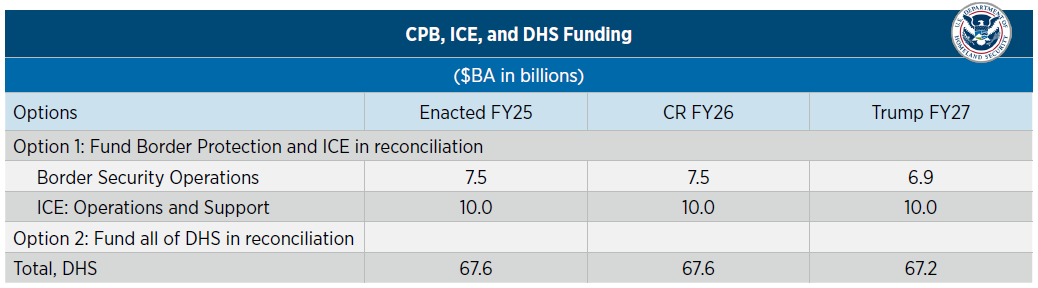
Chart I. Source: DHS
NEXT STEPS
The House and Senate both returned this week from a two-week recess. Thune and Johnson met on April 14 to game out the next steps on getting DHS funded. They will then need to ensure they have the Republican votes necessary to pass the bill in the House and Senate. On April 10, Senate Budget Committee Chairman Graham (R-SC) stated the Senate was going to move forward with reconciliation “to prove to the House that we’ve got the votes.” It appears Senate Republicans plan to initiate a budget resolution next week instructing the Senate Homeland and Judiciary Committees to develop a reconciliation bill to fund DHS Border Security and ICE for FY26-28.
Reconciliation allows Senate Republicans (who have 53 in their caucus) to avoid a filibuster and pass legislation with just 51 votes, Speaker Johnson currently only has two votes to spare on party-line votes and has experienced defections.
Reconciliation is a cumbersome process that requires Congress to first adopt a budget resolution, which then triggers a reconciliation bill (see primer). One example of these challenges is that while Democrats cannot filibuster a budget resolution or a reconciliation bill in the Senate, they can subject Republican senators to dozens of votes.
The President’s June 1 deadline is ambitious. Assuming the Senate moves a budget resolution next week, that leaves 6 weeks for a Republican Congress to complete action and send a reconciliation bill to the President. In recent years, the fastest Congress has completed the entire budget reconciliation process has been 5 weeks and that was at the beginning of the Biden Administration in 2021 when Congressional Democrats were largely unified in the need to move quickly in response to COVID with the American Rescue Plan Act. Last year, congressional Republicans met President Trump’s July 4 deadline for approval of the One Big Beautiful Bill Act.
While the President and Republican leadership have embraced limiting this second reconciliation bill to just CBP and ICE funding, there are likely to be efforts to expand it to cover other items. Other potential candidates for reconciliation include: a $350 billion increase in the defense budget proposed in Trump’s FY27 budget, funding for the Iran war, the SAVE Act (a bill with new voting requirements), among others. In addition, many Republicans are urging that reconciliation be used to reduce spending to bring down deficits and debt.
Republican fiscal hawks have raised concerns that the reconciliation bill’s cost should be offset. If limited to DHS funding, although the bill will be scored as increasing mandatory spending, the practical effect of it will be to supplant the need for discretionary appropriations for Border Security and ICE that Republicans already voted for. Therefore, they can make the case that the bill has no net cost when the reduced need for appropriations to fund these two agencies is taken into account.
President Trump and Republican leaders have embraced the narrow reconciliation strategy to fund just Border Security and ICE. If the bill is kept narrow in scope to just these two DHS agencies, we think it increases the odds for its enactment and it unlocks completion of the FY26 appropriations bill funding the remainder of the department, which only needs to pass the House. If other unrelated provisions are added to reconciliation, we think those odds are reduced. To address the demands that additional priorities be addressed in reconciliation, the House and Senate Budget Committee Chairs (Arrington and Graham) have proposed a third reconciliation bill to address these other priorities.