
April 22, 2026
Final FY27 Federal Appropriations Unlikely Until December (for a few) or March (for most)
With regard to FY27 spending decisions, delays in the President’s budget request, the lack of statutory spending caps, uncertainty about funding the war in Iran, Farm Aid and disaster relief, delays in agency budget hearings, the ongoing DHS shutdown, uncertainty about whether there will be a second or third reconciliation bill, and the election season will inevitably result in a continuing resolution (CR) to start the fiscal year in October. Congress is scheduled to be in recess for the entire months of August and October, so final spending decisions are not likely until after the November mid-term elections or, depending on the election results, the next Congress.
THE PRESIDENT’S BUDGET
On April 3, the President submitted a partial FY27 budget to Congress. While it includes detailed proposals for the $1.8 trillion discretionary budget, most of the supporting documents for the discretionary budget will not be released until next week. The budget includes no proposals for mandatory programs such as Social Security, Medicare, and Medicaid, or for changes in tax law or tariffs. The April 3 budget release does little to resolve the many open questions that inevitably delay completion of the FY27 appropriations process. In fact, the budget will likely make delay more certain.
The President proposes $1.504 trillion for national security programs, a 42% increase. The President is proposing that $350 billion of the $1.5 trillion for national security programs be enacted through the reconciliation process and approximately $100 billion of the increase through the appropriations process, complicating completion of the national security budget. Congress will need to determine whether the reconciliation bill is written by the Armed Services Committees rather than by the Appropriations Committees. Recently, the House Appropriations Committee delayed their markup of the Defense bill from May until mid-June.
While proposing a 42% increase for national security programs, the President proposes a 10% cut in non-defense programs. While the President proposes some initiatives in the non-defense portion of the budget he also proposes deep cuts in science programs, health care, foreign assistance, environment, education, and housing. He also proposes cuts in so-called affordability programs, such as childcare, the Low-Income Home Energy Assistance Program, nutrition assistance, and housing assistance. Virtually all of these cuts were rejected by Congress in the FY26 process and are likely to be rejected again.
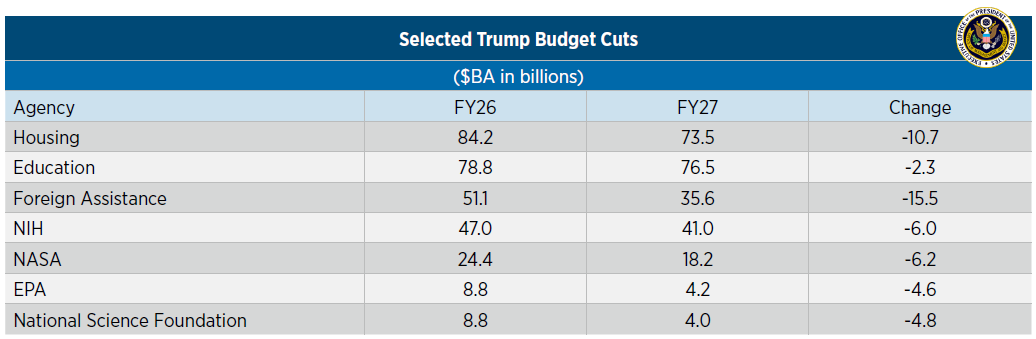
Chart I. Source: OMB
WAR IN IRAN
The President’s April 3 budget does not include a request for the costs of the war in Iran, nor a proposal on how to finance such costs. DOD Secretary Hegseth originally asked the White House to propose $200 billion, but recent press reports indicate that the number from the White House may be in the $80-98 billion range. In testimony this week, OMB Director Russ Vought indicated that the request was not ready, as they review FY26 and potential FY27 costs.
HOUSE AND SENATE APPROPRIATIONS COMMITTEE ACTION ON FY27 BILLS
House Appropriations Committee Chairman Cole (R-OK) has announced a revised schedule for marking up the FY27 bills, beginning April 17 through June 24 (Chart II). Given the delay in the President’s budget, subsequent delays in budget hearings (where agency heads make the case to the appropriations committees for budgets), and the lack of agreement on spending toplines, the most likely outcome is that the House Appropriations Committee produces partisan bills approved in Committee on party-line votes as they did in FY26.
Senate Appropriations Committee Chair Collins (R-ME) expects the Senate Committee to mark up bills in June and July with a few of the bills going to the Senate floor in a so-called minibus in July. The key issue in determining whether the Committee can continue the bipartisan approach taken in FY26 will be whether leadership decides to use a reconciliation bill for the proposed $350 billion increase for national security programs, or whether Republicans will insist on cuts to non-defense programs to pay for the national security increase.
Further complicating the ability of the Senate to reach a bipartisan agreement are several increases that need to be accommodated within the non-defense topline. In FY26, the final agreement assumed a freeze at FY25 levels for non-defense programs. In FY27, a freeze at FY26 levels will be difficult because of the President’s proposal to increase VA by $11.5 billion, a $15 billion shortfall in Pell Grant (higher education) costs, and an estimated $10 billion reduction in HUD receipts.
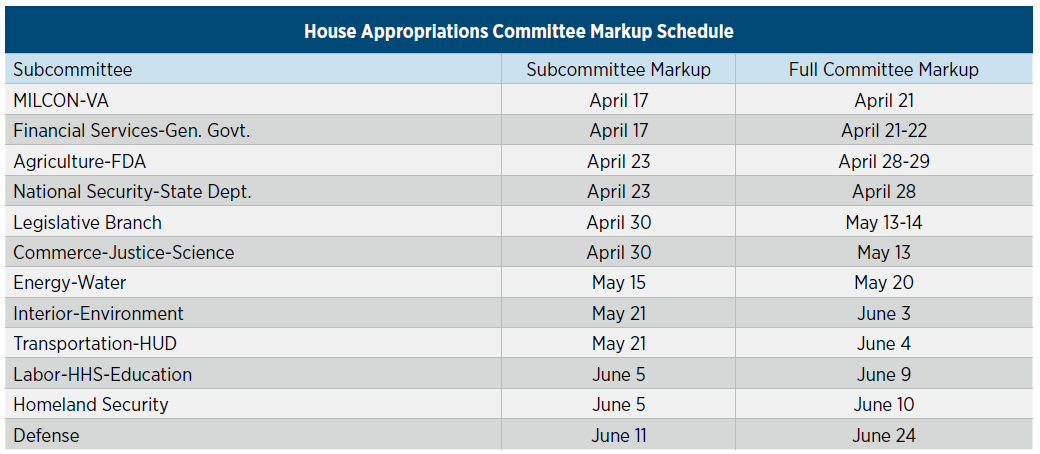
Chart II. Source: FBIQ
ENDGAME
Given all this uncertainty, we expect federal agencies to operate under CRs for at least the first 10 weeks of FY27 with the November mid-term election results influencing both the timetable and the results of final negotiations.