
October 20, 2025
FY26 Appropriations – Compounding Uncertainty

The longest Federal government shutdown was in FY19, when much of the government was closed for 35 days due to a dispute over President Trump’s desire to fund the Southwest Border wall. For FY26, the government is once again shut down, seventeen days and counting. It is not clear when the shutdown will end.
On September 19, 2025, the House passed (217-212) a continuing resolution (HR 5371) to extend government funding at current levels through November 21, 2025. The Senate, as of October 16, has voted on the House bill 10 times and failed to get sixty votes each time. In the meantime, the House has been on recess for nearly a month, rejecting any compromise.
Senate Democrats offered an alternative CR that has also failed to get sixty votes. The alternative would have permanently extended Affordable Care Act premium subsidies, repealed over $1 trillion of Medicaid cuts that were enacted in the reconciliation law (PL 119-21), extended the availability of funds that lapsed on September 30 as a result of OMB unilaterally blocking obligations, and prevented so-called pocket rescissions.
This could be the longest government shutdown in US history.
House Speaker Johnson (R-LA),
October 13
The funding hiatus has resulted in over 700,000 Federal employees being furloughed, over 4,100 Federal employees being fired (Reduction in Force), services being delayed, over a million employees working, but not being paid or partially paid, contractors not being paid, and further delays in efforts to move forward on the FY26 appropriations process. Examples of service impacts include flight delays, fewer services available at Social Security Administration, less access to national parks, taxpayer phone lines at the IRS going unanswered, delayed preparation for the 2026 IRS filing season, and less access to services for veterans.
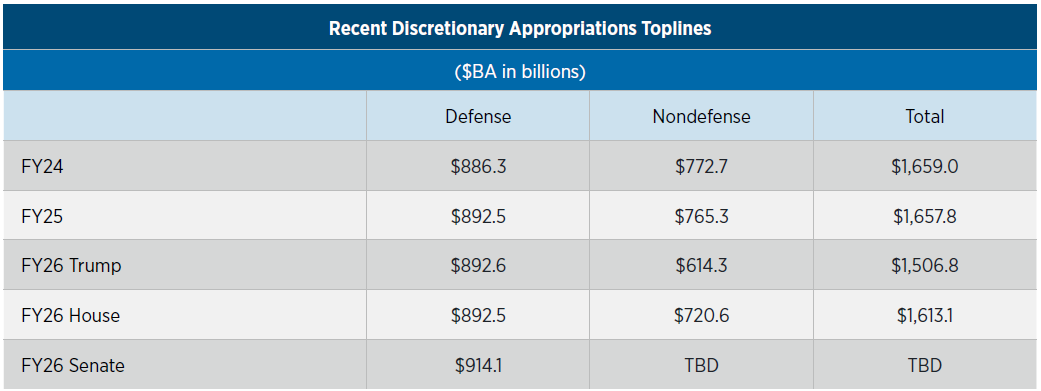
Chart I. Source: OMB, CBO, House and Senate Appropriations Committees, FBIQ
Neither side has been willing to negotiate. Republican leadership has argued that the House version of the CR is “clean” funding at FY25 levels and FY25 terms and conditions, similar to CRs enacted during the Biden Administration. Democrat leadership has argued that the House CR is not clean because it allows Affordable Care Act premium subsidies to expire and does nothing to restore Congress’ power of the purse.
In the meantime, progress on negotiating the full year FY26 appropriations bills has stalled. Major issues, such as the toplines on spending for defense and non-defense programs and the disposition of so-called poison pill environmental, abortion, family planning, diversity and other riders remain unresolved. There could also be new issues, such as assistance for Ukraine, Gaza, and Israel. There is also expected to be pressure to compensate farmers for the impact of the President’s tariff policies on soybeans and other products.
The President has asserted that he has the unilateral authority to cancel spending that he signed into law, undermining the confidence required in Congress to negotiate final appropriations bills. Until this issue is resolved, further progress on most of the FY26 bills is unlikely.
Having already accomplished his major appropriations goals (funding for the border wall, for immigration enforcement and detention, and for the Golden Dome anti-missile system) through enactment of the One Big Beautiful Bill Act (PL 119-21), President Trump has little to gain from completing the FY26 appropriations bills that would limit the level of discretion he had in FY25, particularly in the continuing resolutions (CRs) adopted in March. It appears that the President’s goal is adoption of another full-year continuing resolution (CR) like the one he signed in March for FY25 (PL 119-4). Under such a CR, funding continues at the prior year level, under prior year terms and conditions unless there is special treatment (an “anomaly”). Funding is provided at the account level, allowing considerable discretion to the President and OMB to move money around within accounts for most of the bills.
Recent actions by the President and OMB Director Vought compound the uncertainty for the path forward. The OMB Director has threatened to increase the number of reductions in force for civilian employees to 10,000, though a federal district court issued a temporary restraining order Oct. 15, blocking such firings.
Also on October 15, the president, in an effort to mitigate the impact of the shutdown, issued an order directing DOD to use $8 billion of research and development funds to cover the costs of military pay for Oct. 15 paychecks. Such use of R&D funds is an apparent violation of the purpose statute (31 USC 1301 (a)) and the Anti-Deficiency Act.
At whatever point Congress is able to reopen the government, there will need to be agreement on the duration of the CR. If, as expected, the shutdown lasts several more weeks, an extension of the November 21 expiration date in the House-passed CR will be needed. Options include extending the pending CR into mid-December, January, or even February. President Trump originally wanted the initial FY26 CR to last until January 31, 2026. If the CR goes beyond January 1, it increases the probability that only a few bills will be completed (there has been significant progress in closed-door negotiations on Military Construction- VA, Agriculture, and Legislative Branch) and the rest of the bills will once again be part of a full-year CR.
As a result of the shutdown and further delays in the FY26 appropriations process, agency decisions on procurements are likely to be pushed well into the spring.