
March 23, 2026
Federal Appropriations–So Many Questions–So Few Answers

First the good news. Eleven of the twelve FY26 appropriations bills (96% of annual discretionary spending) have been signed into law. Funding for the twelfth bill, Department of Homeland Security (DHS), remains on hold. The DHS shutdown began February 14 with the White House and House and Senate Democrats at an impasse on immigration enforcement reforms following the enforcement actions in Minnesota. DHS can’t sign new contracts, make grants, or pay many of its workers. Over 120,000 of the 260,000 DHS employees are currently working without pay.
With regard to FY27 spending decisions, delays in the President’s budget request, the lack of statutory spending caps, uncertainty about funding the war in Iran, Farm Aid and disaster relief, delays in agency budget hearings, resolution of the DHS shutdown, uncertainty about whether there will be a second reconciliation bill, and the election season will inevitably result in a continuing resolution (CR) in October. Congress is scheduled to be in recess for the entire month of August and October, so final decisions are not likely until after the November elections or possibly the next Congress.
In the eleven enacted FY26 spending bills, Congress attempted to reassert its power of the purse by including numerous provisions incorporating specific funding levels into the statutes. What is not clear is whether the Administration will treat those funding levels as ceilings (i.e., they may assert that they can spend less) or as directions to spend at those specific levels. President Trump proposed to cut non-defense programs by 23% for FY26. However, in the enacted laws, the aggregate non-defense funding level was almost the same as FY25. Many agencies (for example NIH, EPA, NASA, CDC, foreign assistance, and HUD) are at levels significantly above the President’s request. In public apportionment documents (the OMB-approved spending levels for each appropriation), many accounts appear to be at the higher enacted levels but are subject to OMB/ agency spending plans that are not publicly available. Resolution of these issues will determine how rapidly agencies can begin spending the money and promulgating funding solicitations later this Spring.
THE PRESIDENT’S FY27 BUDGET
With regard to FY27 spending, the President is expected to submit his budget request in early April, two months after the statutory due date. For the annual discretionary budget, the President is expected to submit a detailed request, which will kick start the FY27 appropriations process. OMB has not announced whether it will submit a complete budget, with revenue and mandatory programs proposals and economic assumptions, missing elements in the FY26 budget.
The President has announced that his FY27 budget will propose $1.5 trillion for national security programs, roughly $500 billion above FY26. He has not yet announced whether he intends to repeat his effort to substantially reduce non-defense program funding levels. Nor is it clear whether the President intends to propose that Congress use the reconciliation process to enact the proposed $500 billion increase for national security. There are no statutory caps on spending for FY27, so the President could leave for Congress the decision on whether to enact the increase through the appropriations process or reconciliation. Speaker Johnson (R-LA) announced this week that House Republicans are actively considering using the reconciliation process for the proposed national security increase and potentially the Iran war supplemental (which could pass the Senate with a majority vote, rather than appropriations bills that require sixty votes).
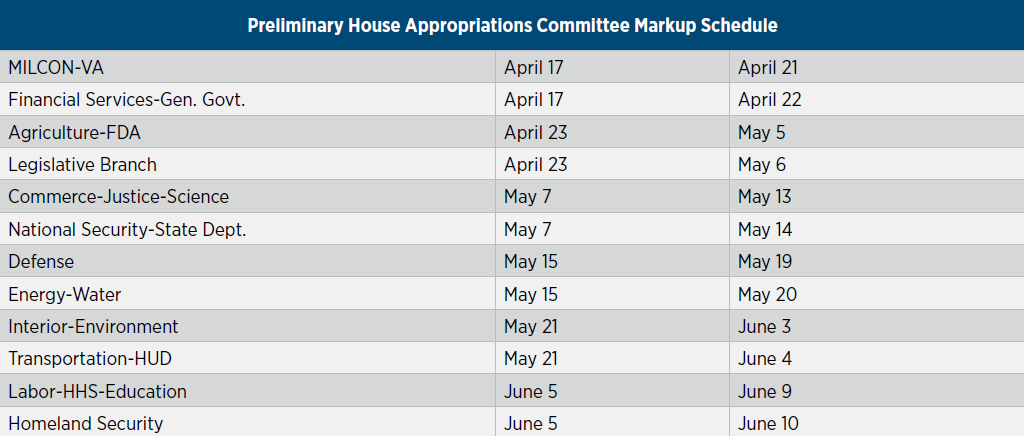
Chart I. Source: FBIQ
HOUSE AND SENATE APPROPRIATIONS COMMITTEE ACTION ON FY27 BILLS
House Appropriations Committee Chairman Cole (R-OK) has announced an ambitious schedule for marking up the FY27 bills, beginning April 17 through June 10 (Chart I). Given the delay in the President’s budget, subsequent delays in budget hearings (where agency heads make the case to the appropriations committees for budgets), and the lack of agreement on spending toplines, the most likely outcome is that the House Appropriations Committee produces partisan bills approved in Committee on party-line votes as they did in FY26.
Senate Appropriations Committee Chair Collins (R-ME) has not yet announced her schedule for mark ups, but it is expected that the Committee will mark up bills in June and July. The key issue in determining whether the committee can continue the bipartisan approach taken in FY26 will be whether leadership decides to use a reconciliation bill for the proposed $500 billion increase for national security programs, or whether to use the appropriations process. If it is the latter, the question will be whether Republicans insist on cuts to non-defense programs to pay for the national security increase.
FUNDING THE WAR IN IRAN
The President has not yet requested funding for the cost of the war in Iran. Estimates of the cost for the first week alone are $11.3 billion. Also pending are potential requests for aid to the farm sector, and disaster assistance. If the President requests such assistance, Congress will need to determine whether to pay for it with cuts to other activities or designate the funding as an emergency. Congress will also need to decide whether to use the reconciliation process, which could take months to adopt, since Congress must pass a budget resolution in order to instruct committees to mark up reconciliation legislation. On March 19, Defense Secretary Hegseth argued for $200 billion but the White House has not yet determined how much to request or when.
END OF THE ROAD?
Given all this uncertainty, we expect federal agencies to operate under continuing resolutions for at least the first 10 weeks of FY27 with the November mid-term election results influencing both the timetable and the results of those negotiations.