
October 26, 2026
November Arrives with a Heavy Lame Duck Agenda
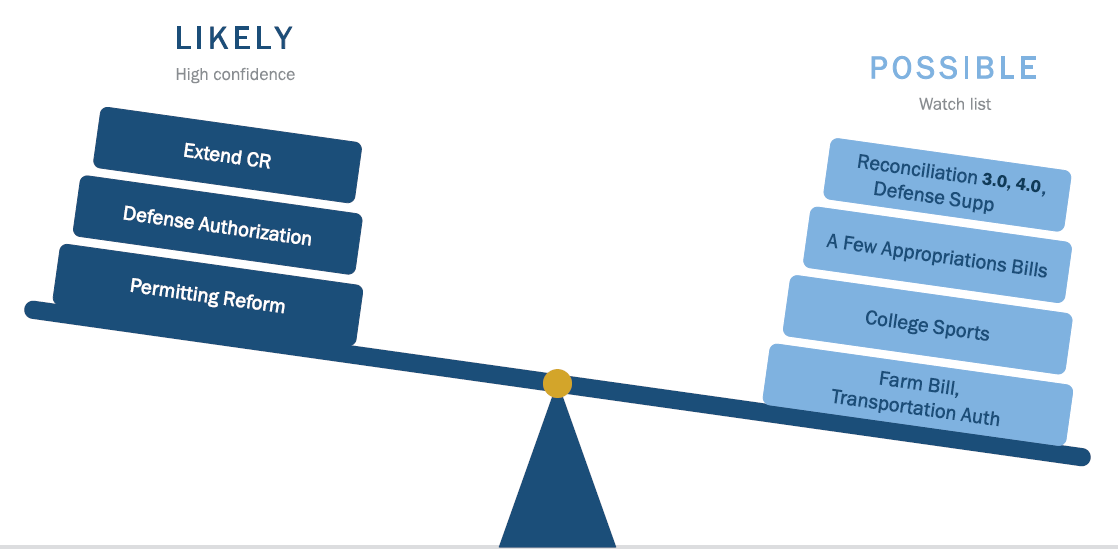
The post-election “lame duck” period for the 119th Congress is comprised of 24 days in session, spanning November 9 to the third week of December, with Thanksgiving week and weekends off. The legislative agenda includes almost everything Congress left unfinished in 2026–a myriad of spending and policy bills, some of which have been in process for the entirety of the 119th Congress or longer. All pending legislation, even bills that have passed the House or Senate, are wiped from the legislative docket at the end of a Congress. When the new Congress is sworn in on January 3, 2027, it will start from scratch—but almost certainly with a large plate of cold leftovers.
Actions that Congress must, should, or would like to finish in 2026 include:
- FY27 A Continuing Resolution (CR) covering all of the federal government that lasts through December 11 is in place. Before that deadline, appropriators may try to complete several of the twelve spending bills. The House has passed three spending bills; the Senate none. However, given challenges surrounding top-line spending numbers and defense vs. civilian funding, it is most likely that the only appropriations action in a lame duck will be a CR extension into February or March 2027.
- Defense Authorization. The House and Senate Armed Service Committees are reportedly close to working out an FY27 authorization compromise bill. This will include policy decisions, authorization of new programs, and recommended funding Defense authorization is the lone authorization bill that Congress completes every year and there is huge pressure to continue that accomplishment. Note that the authorization bill does not provide funding.
- Supplemental The administration requested $88 billion in supplemental funds in June to support the war in Iran and for other purposes. Of the total, $67 billion is for the Department of Defense/War (DOD) and $11 billion is aid for farmers. Within the funds for DOD, $20 billion is to replace munitions used in Iran, $17 billion is for logistics, and $12 billion is for intelligence functions. Congress has not acted on the request, apart from the Budget Committees issuing instructions to affected authorizing committees. This package is commonly called “Reconciliation 3.0”.
- College Sports Act. The Senate passed this bill, which sets standards and limits for conference membership, transfers and use of Name, Image and Likeness, in September. It may hit a snag in the House over players’ rights, such as whether they can be classified as university employees.
- Permitting Completion of bipartisan legislation to accelerate environmental review for energy, infrastructure, transmission, mining, and manufacturing projects was announced by the Senate authorizing committee in September. The bill is a negotiated follow-on to House and Senate work on permitting reform over the last two years. Despite some issues with the bill related to Tribal consultation, expect this to be passed in the lame duck session.
- Farm Bill The House and Senate Agriculture Committees have been negotiating a myriad of expired authorizations and new policy issues for the past three years, since the 2018 Farm Bill terms expired in 2023. The current financial stress of farmers, ranchers and the agriculture community overall have made writing the policy bill more challenging. Further, the Farm Bill sets policy for feeding and nutrition programs, such as the Supplemental Nutrition Assistance Program (SNAP), which have been limited by the administration. Cuts to SNAP have created concern, especially from Democrats. The House passed its version of the Farm Bill in April, and in September the Senate Agriculture Committee approved legislation but without bipartisan support.
- Transportation The Surface Transportation Authorization Act, which steers massive resources to states for highways, bridges, public transit and rail, expired on September 30. The House Transportation and Infrastructure Committee approved their bipartisan version of the authorization in May, but it has not come to a full vote in House. The Senate authorizing committee has not acted. The CR included provisions to extend the expired surface transportation at lower funding levels, until December 11.
- Republican leadership has been considering another budget reconciliation bill (a follow-up to the One Big Beautiful Bill enacted July 4). Reconciliation legislation requires a simple majority vote (i.e. 51 votes in the Senate) and is an option in the lame duck session if it is crafted to secure—and hold—almost every Republican vote. The Reconciliation 3.0 instructions to authorizing committees covered the June supplemental request, but not the $350 billion that the administration seeks for DOD in addition to its FY27 appropriations budget request. Reconciliation 4.0 for that $350 billion has not gotten to the first step—consideration by the House and Senate Budget Committees. Lack of unanimous Republican support coupled with the administration’s recent concessions to Russia may tank this effort.
- Debt U.S. debt is now over $40 trillion, and the statutory debt limit is $41.1 trillion, as explained by the Congressional Research Service. Current estimates are that the U.S. will reach the debt limit in early to mid-2027. The Trump Administration may seek to include a debt limit increase in a reconciliation bill to avoid having to negotiate with the new Congress or add it to a must-pass CR.
- The Foreign Intelligence Surveillance Act (FISA) This law allows information collection, including texts, calls, and emails, on foreigners outside the U.S. as well as other information collection. FISA authority expired in June but is reported to have been extended by a classified court order. Privacy concerns make this controversial for some members on both sides of the aisle.
COUNTING VOTES IN THE LAME DUCK
If crafting challenging pieces of legislation is not enough, counting votes will require alchemy. Of the current 433 members of the House, 60 (almost 14%) are not seeking re-election (retiring, resigning, or running for other office), and 11% of the Senators are not seeking re-election. Additional representatives and Senators will lose on November 3. House and Senate leadership don’t know which members will show up in November and how long they will stick around. There is a great deal of volatility in any lame duck session, and little incentive for defeated or retiring members to travel to Capitol Hill to work out of temporary swing space in the basement while packing boxes in their former offices.
EXPECT LEAD CHANGES, UPSETS, AND ABSENCES
In the lame duck, both parties will be simultaneously electing their leadership and setting priorities and committee membership for the 120th Congress, while balancing the leftover but necessary legislative responsibilities from the 119th Congress. To do that, for House and Senate Leadership of both parties, attendance issues will be paramount. In particular, watch for Republican members who lose reelection on November 3, or were targeted for defeat in a primary by President Trump. With tight margins and a contentious mood, the majority’s House and Senate leadership will have an extremely challenging time to pass any legislation, especially in December when attendance drops off. If Democrats win the majority in the House or Senate (or both) for the 120th Congress, they may not be amenable to a rushed compromise with their Republican counterparts or the White House. Regardless of the numbers, Russia and Iran issues will be highly contentious and reduce the potential for deal-making on any legislation in the lame duck session.