
On September 30, Defense Secretary Hegseth signed a memorandum that outlines the creation of Project Agincourt which will lay the framework for the Autonomous Warfare Command —a new combatant command for unmanned autonomous warfare—with a target establishment date of October 1, 2027. This comes on the heels of a June 29, 2026 memorandum that calls for the consolidation of all unmanned and autonomous systems under a new position, the Direct Reporting Portfolio Manager for Unmanned Systems (DRPM-UxS) which is a direct report to the Deputy Secretary.
As Artificial Intelligence (AI) and autonomous machines slowly creep into our daily lives, it is understandable that these technologies are swiftly being employed by the Department of Defense (DOD). Even as the Replicator program was restructured into the Defense Autonomous Warfare Group (DAWG) and the Modular Advanced Surface Craft (MASC) program was canceled, DOD has been pushing towards the integration of autonomous systems into daily life and operations.
Within the last year, the Department made a number of significant announcements highlighting its operational use of autonomous systems. It is not new to write about these systems and to ascribe budgetary dollars to them from a conceptual standpoint, but as these announcements reveal, DOD is transitioning from operational concepts to experiments and actual operations for some very capable autonomous systems.
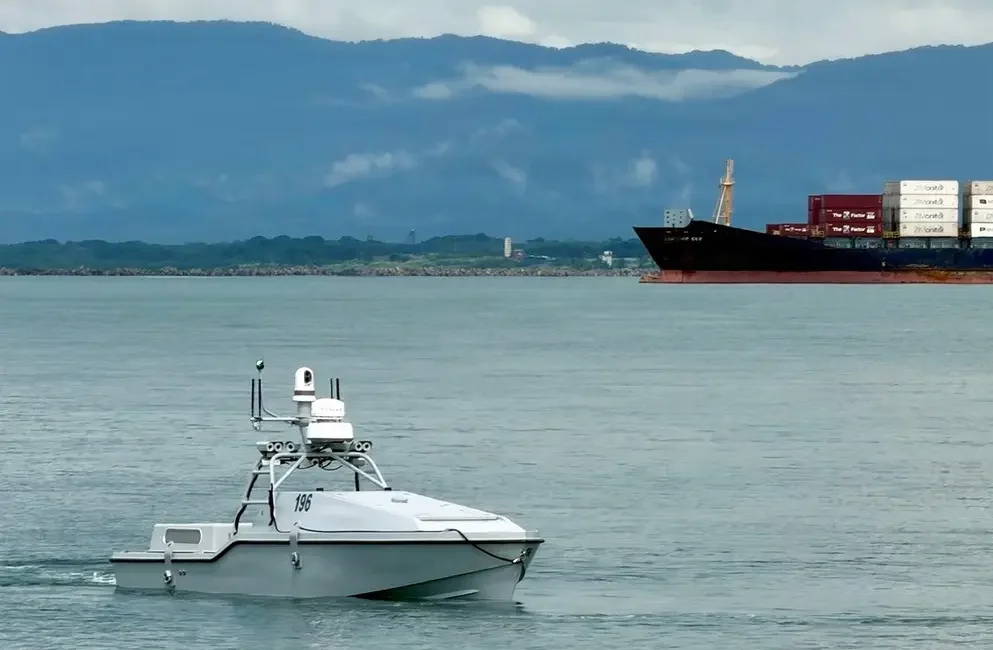
Using the Corsair uncrewed surface vessel to help rescue downed AH-64 pilots off the coast of Oman last June was a high-profile example. The US 5th Fleet’s Task Force 59 began fielding the autonomous vessel in March after a $322 million December 2025 contract award using Other Transaction Authority (OTA). The flexibility offered by this sort of procurement allowed the Secretary of the Navy to shorten the “prototype to production” timeline to under 12 months.
This same platform participated later in the summer in a maritime exercise (Exercise Panamax 2026). It performed well and the US Embassy and Southern Command (SOUTHCOM) coordinated with Panama’s Ministry of Security to keep the Corsairs for maritime security missions conducted in a partnership with Panama’s National Aeronaval Service. The Corsairs will be used for territorial water protection, counter narcotic missions, and improving security along established and critical maritime routes. Designed to operate reliably without a crew on board, the Corsair can maintain a persistent patrol presence and augment a nation’s existing maritime fleet.
While not fully operational, the Navy is also experimenting with autonomous systems to assist with at-sea refuelings. In August and September, the Naval Air Warfare Center Weapons Division tested a towable robotic refueling system with the intent of keeping uncrewed vessels at sea for a longer period. The Navy tested a robotic capture and connection device manufactured by Sealartec which successfully refueled the MARTAC T38 Unmanned Surface Vessel (USV). The importance of these fully robotic systems is that they allow for operations in contested environments with little threat to the warfighter.
The Naval Air Warfare Center’s Aircraft Division (NAWCAD) successfully tested an unmanned system’s ability to land aboard a ship without either GPS or pilot control. Once incorporated into systems, this capability allows the Navy to operate aerial systems in contested areas where satellites and communications are jammed. This software-driven approach pairs cameras with advanced guidance, navigation, and control software with the potential to replace much more expensive radar-based systems.
Along the same lines, this month, the Navy also tested the MQ-25A Stingray, an unmanned aerial refueler controlled from the USS Ronald Reagan (CVN-76). While not completely autonomous since the Stingray is flown by operators on the carrier, this test was performed at over 2,100 miles using a proliferated low earth satellite network (pLEO). The use of these aerial refuelers increases the reach of carrier aerial operations.
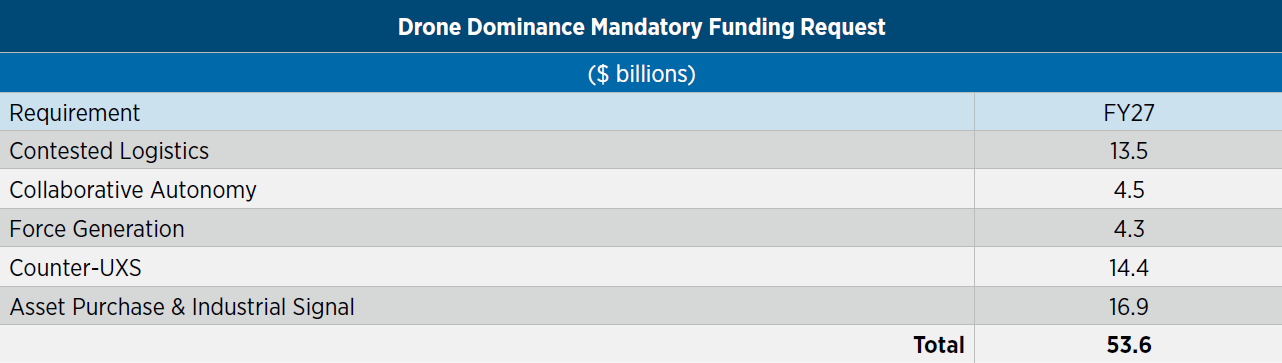
The Department requested $54.6 billion for DAWG in FY27 which is an enormous increase over the previous year’s funding of $226 million. This increase is understandable since the DAWG did incorporate the Biden-era Replicator program and is tasked with operationalizing all the Department’s autonomous warfare efforts. Unfortunately, the Department only chose to request $1 billion of the $54.6 billion in its normal discretionary request in the Defense Wide RDT&E account. The other $53.6 billion is included in President Trump’s $350 billion FY27 mandatory request which is dependent on a Trump-backed reconciliation 4.0 bill that has not materialized and is highly unlikely to materialize this year.
This Drone Dominance mandatory request was directed to the DAWG and broken out into the five categories displayed in Chart I.
Source: Department of War Mandatory Budget Overview
WHAT’S NEXT?
The rapid technological advances and successful operation of autonomous programs are going to drive their continued demand. The funding for innovation imagined by the Department is not going to take place at anticipated levels until the Department works more closely with Congress on a transparent plan that is funded through the normal appropriations process.
The mid-term elections suggest single-party rule will end next year. That makes reconciliation bills for new spending virtually impossible – especially for items which are traditionally funded through discretionary programs. For FY27 we don’t expect to see spending for the DAWG increase to anywhere near Trump’s proposed $55 billion but wouldn’t be surprised to see an increase above the $1 billion discretionary request in the final FY27 appropriation.