
September 22, 2025
Here We Go Again: Shutdown or Government by Continuing Resolution?
The new fiscal year begins on October 1, 2025. None of the twelve FY26 appropriations bills have been presented to the President. With less than two weeks to go, the House has only passed three bills (Military Construction-VA, Defense, and Energy and Water). The Senate has passed only three bills (Military Construction-VA, Agriculture, and Legislative Branch).
The House, Senate, and President have taken fundamentally different approaches to FY26 appropriations. There is no agreement on spending toplines for the bills. The House takes a partisan approach, freezing defense spending at the FY25 level consistent with President Trump’s FY26 Budget, cutting non-defense programs by 6%, and filling the bills with so-called “poison pill” riders that focus on the environment, abortion and family planning policy, and diversity. The House has taken no action to constrain OMB Director Vought’s assertion that the President can unilaterally reduce spending levels that have been signed into law. The Senate has written bipartisan bills that increase defense spending by $21 billion, funds non-defense programs at levels at least $45 billion above the House, and avoid new poison pill riders.
The President proposed a freeze in defense spending and a 20% cut in non-defense programs, with dramatic reductions proposed for public education, housing, EPA, the National Institutes of Health and the Centers for Disease Control, foreign assistance, and Federal staffing levels.
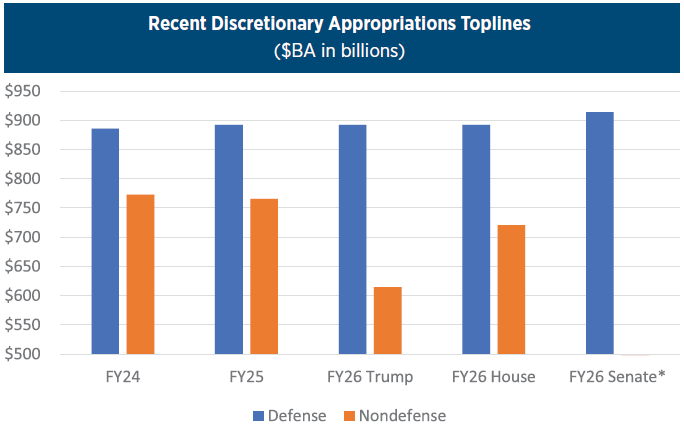
Chart I. Source: OMB, CBO, House and Senate Appropriations Committees, FBIQ
The President has asserted that he has the unilateral authority to cancel spending that he signed into law, undermining the confidence required in Congress to negotiate final appropriations bills. The President has already accomplished his major appropriations goals (funding for the border wall, for immigration enforcement and detention, and for the Golden Dome anti-missile system) through enactment of the One Big Beautiful Bill Act (PL 119-21). Thus, the President has little to gain from completing the FY26 appropriations bills and much discretion to gain through enactment of continuing resolutions with, typically, minimal congressional direction. It appears that the President’s goal is passage of another full-year continuing resolution (CR), such as the CR that he signed for FY25 (PL 119-4). Under such a CR, funding continues at the prior year level, under prior year terms and conditions. Funding is provided at the account level, allowing considerable discretion to the President and OMB to move money around within accounts.
“Don’t even bother dealing with the Democrats.” “In times like these, Republicans have to stick TOGETHER to fight back against the Radical Left Democrat demands.”
President Trump,
September 15
The unresolved funding issues will have significant consequences. For example, the Senate version of the Labor-HHS- Education bill eliminates many of the funding cuts in the House bill for public education, for the National Institutes of Health, and the Centers for Disease Control. The Senate version of the Defense bill has $20 billion of increases above the House for shipbuilding, air defense, munitions, and international responsibilities such as Ukraine. The Senate Commerce-Justice-Science bill eliminated significant reductions contained in the House version of the bill for the FBI and National Science Foundation.
As a result of these unresolved major differences, for the 29th year in a row, Congress is preparing a continuing resolution to begin the fiscal year. The issue now is whether Congress can pass a CR or whether there will be a partial government shutdown. The President, House and Senate Republican and Democratic Leaders are already playing the blame game in an effort to blame any shutdown on the other party. Republican Leadership is following the President’s lead and taking a partisan path in drafting the continuing resolution without negotiations with Democrats.
House Republican Leadership has decided they would rather take us to the brink of a shutdown instead of working with Democrats on a bipartisan continuing resolution to keep the government funded, protect Congress’ power of the purse, and improve health care.
HAC Ranking Member DeLauro (D-CT)
and SAC Vice Chair Murray (D-WA),
September 16
On September 17, the House voted 216-210 (all “yes” votes were from the Republican caucus, with one Republican voting “present”) to pass the rule for consideration of their version of the continuing resolution. No amendments will be in order. The Republican Leadership describes the CR as a “clean” continuing resolution. The draft continues funding for all twelve bills through November 21 at FY25 levels and FY25 terms and conditions. It does include $30 million for member security and $58 million for executive and judicial branch security. It does nothing to constrain the President’s assertion that he can unilaterally cancel spending. It does not include an extension of Affordable Care Act tax credits for reduced health insurance premiums sought by Democrats. The current credits expire on December 31, 2025.
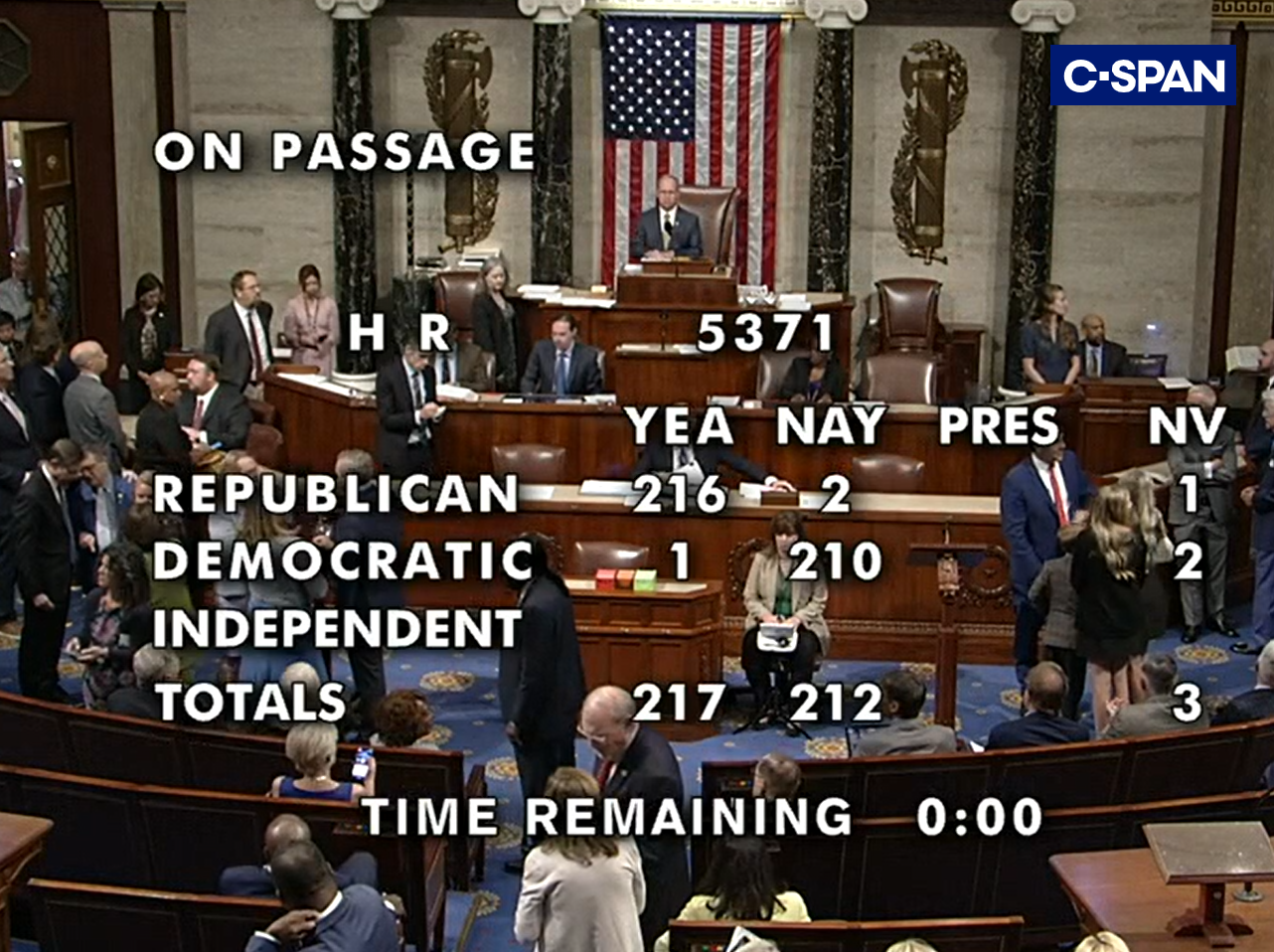
On September 19, the House voted 217-212 to pass the CR. In the Senate, passage will require 60 votes.
On September 17, House and Senate Democrats introduced an alternative CR that extends appropriations through October 31, 2025, permanently extends the Affordable Care Act tax credits, repeals the OBBB $1 trillion cuts in Medicaid, extends the availability of appropriations inappropriately withheld by OMB that otherwise lapse on September 30, and blocks the President’s assertion that he can cancel spending without the approval of Congress.
Under a bipartisan agreement, the Senate will vote today on both the House-passed CR and the Senate Democratic Alternative. Since neither option is expected to get the 60 votes needed for adoption, the decision on next steps will be deferred until September 29 when the Senate reconvenes. In the interim, Senate Majority Leader Thune (R-SD) and Senate Democratic Leader Schumer (D-NY) must decide whether to seek a compromise or elevate the risk of an October 1 government shutdown.
If a CR is not passed by October 1, agencies that are funded with annual appropriations will be required to shut down. Under the terms of the Anti-Deficiency Act, activities that protect life and property can continue, but Federal employees and contractors can’t be paid for that work until a funding bill is enacted. During a funding hiatus, OMB determines what activities can continue (e.g., Federal prisons don’t close, VA hospitals and clinics stay open, Social Security and Medicare checks (that are paid for with mandatory appropriations) continue.
If there is a shutdown, it is unclear how long it will last. Shutdowns have been as short as one day, and as long as 35 days (2018-2019).
FBIQ does not expect an October 1 government shutdown. If there is no bipartisan compromise in this round, the risk of a November shutdown increases.
FORECAST
<20%
A partial government shutdown occurs October 1.